
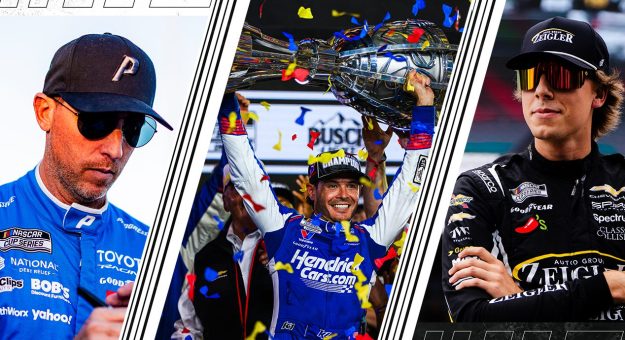
It’s been a few weeks since the end of the 2026 NASCAR season, and we’re still processing what happened over the preceding nine months. From historic winning streaks and late-season surges to a new format that changed how a champion was crowned, there was no shortage of memories that will stick with us for years to come. So with all that just transpired in mind, here are six lessons — with accompanying visual guides — that stood out as we look back upon the season that was:
Kyle Larson belongs among the greats.
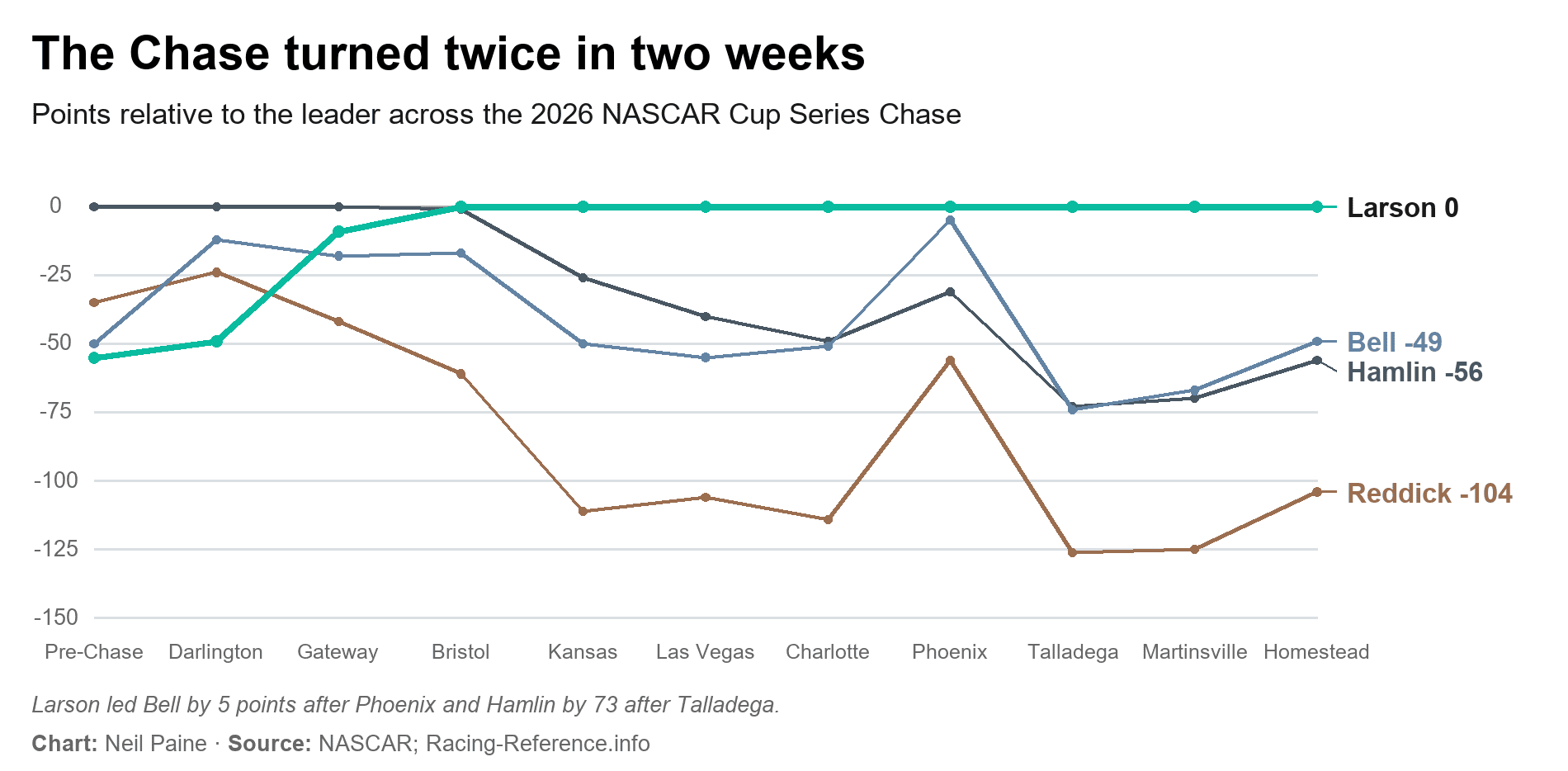
If ever there were any doubts that Larson’s name should be etched into the history books among NASCAR’s greatest-ever drivers, the 2026 season erased them. Larson won his second consecutive Cup Series title — and the third of his career — by going on one of the great late-season runs of The Chase/Playoff era. The No. 5 Hendrick Motorsports Chevrolet won three of the season’s final nine races and zoomed from down 55 points on the eve of The Chase to win it all by 49 points. Larson’s average finish of 7.3 during The Chase itself ranked 9th-best among the 23 Cup champs of the “postseason” era (since 2004).
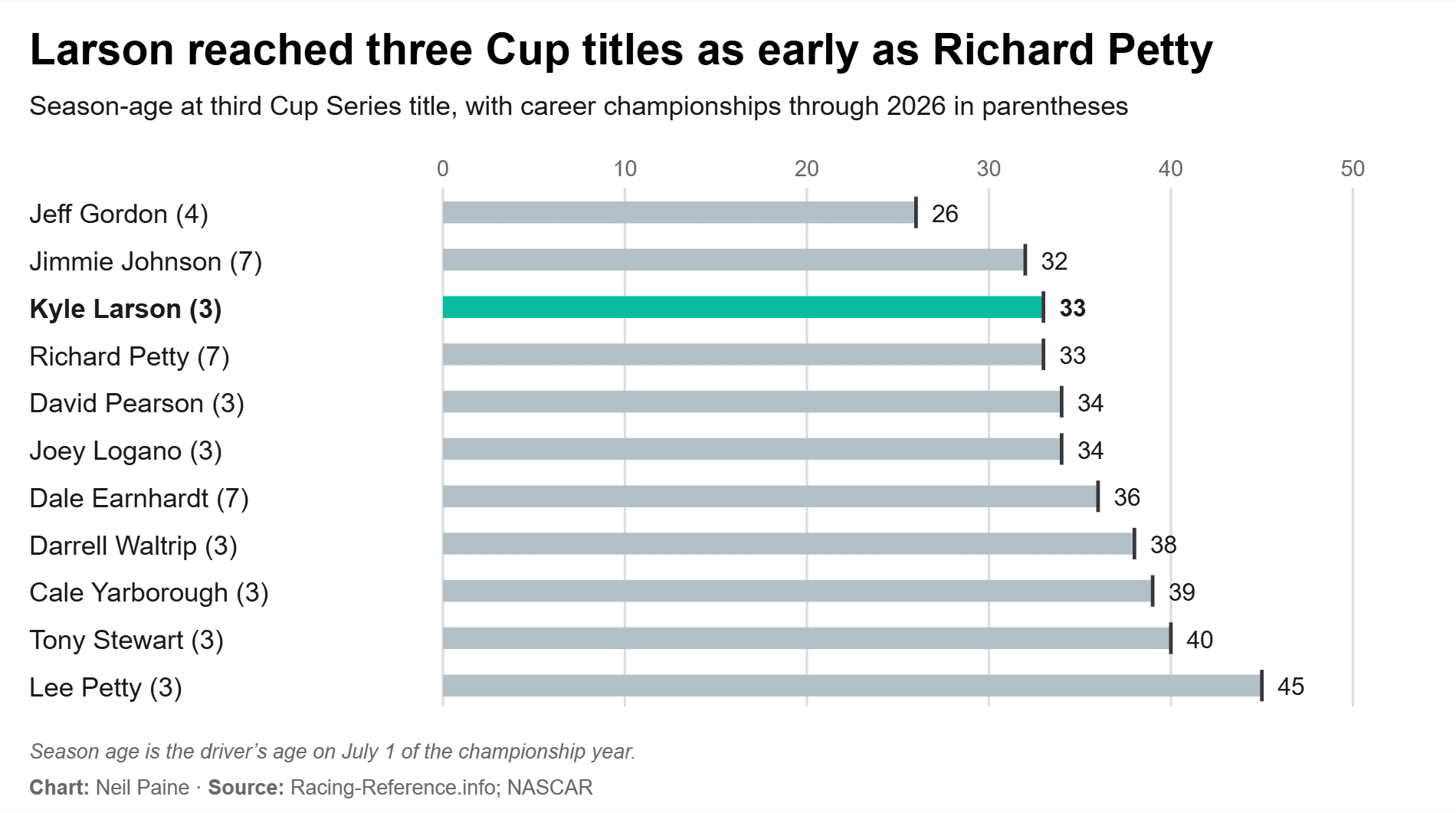
As we noted in the wake of Larson’s championship victory, he has now joined a pretty special group by winning three titles through his age-33 season (per Racing-Reference’s season-age conventions). That ties none other than “The King,” Richard Petty, for third-youngest at the time of a driver’s third career crown, trailing only the early paces set by Jeff Gordon and Jimmie Johnson. And it leaves plenty of time for Larson to climb even higher.
If Denny Hamlin didn’t get it done this year, it may never happen.
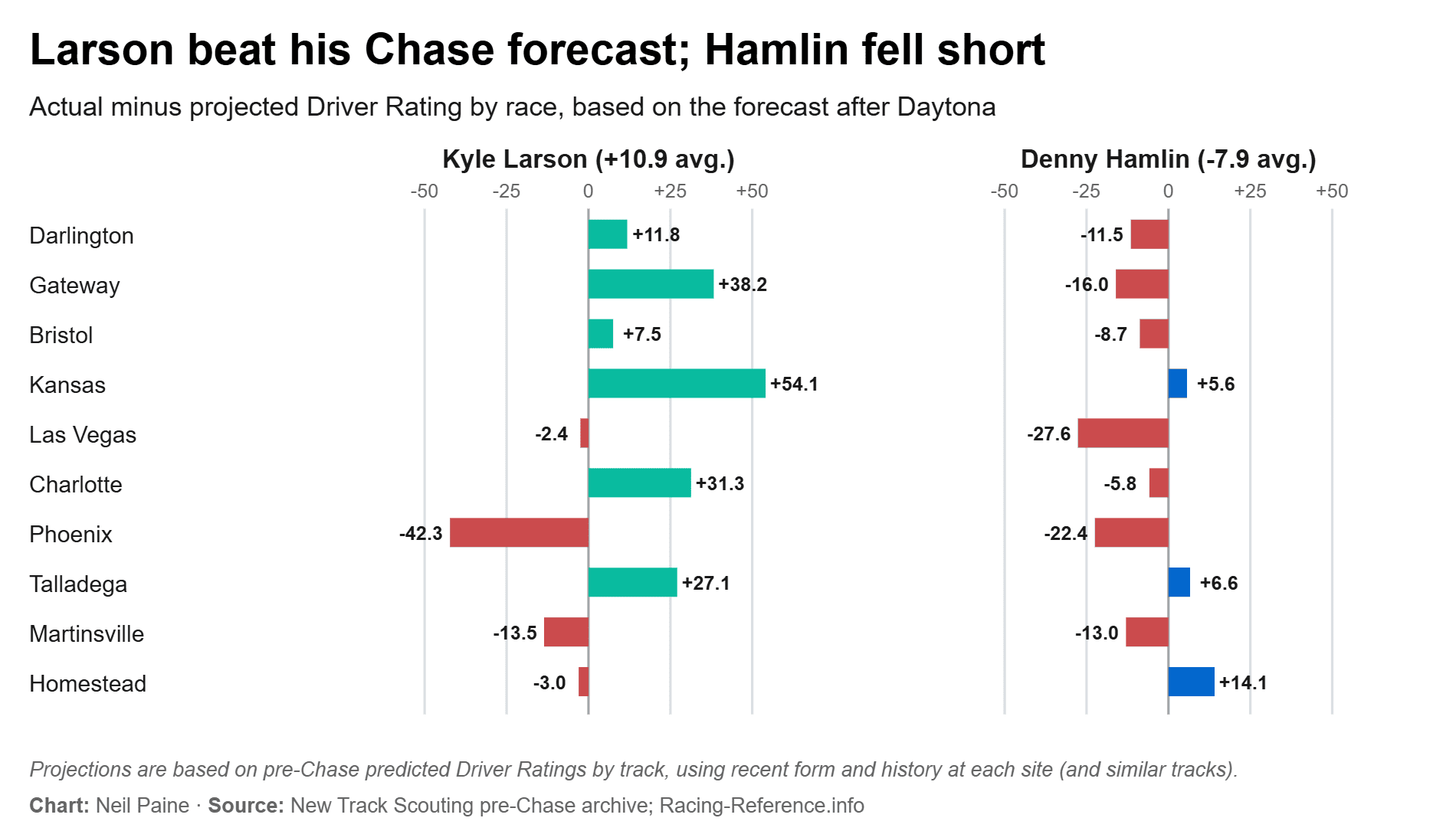
Of all the disappointing ways Denny Hamlin has found to not win a championship over the years, 2026 might somehow have represented a brand-new variation on the well-worn concept. Unlike disasters like 2025, when Hamlin legitimately had the title within his grasp late in the finale, or even multi-race collapses like 2010, this year was more of a failure to launch entirely. Hamlin averaged a 10.7 finish and a 96.1 Driver Rating in The Chase — down from his respective rates of 8.2 and 100.6 from the regular season — and he only scored a single podium finish (third, Kansas) with another lone top five at Charlotte Motor Speedway.
What made this fairly unremarkable (by contender standards) run so underwhelming was the fact that The Chase itself was stocked with so many favorable tracks for Hamlin, based on his previous performances and general track-type affinities. There were far more intermediates and short-flat tracks than usual — Denny’s best track types — and far fewer road courses and drafting tracks, where he’s struggled recently. Yet, while Larson matched or exceeded his projections throughout The Chase (see above), Hamlin failed to meet his most races, leading to a huge missed opportunity at age 45. He may not get another chance as good next year.
The Chase changed the championship equation.
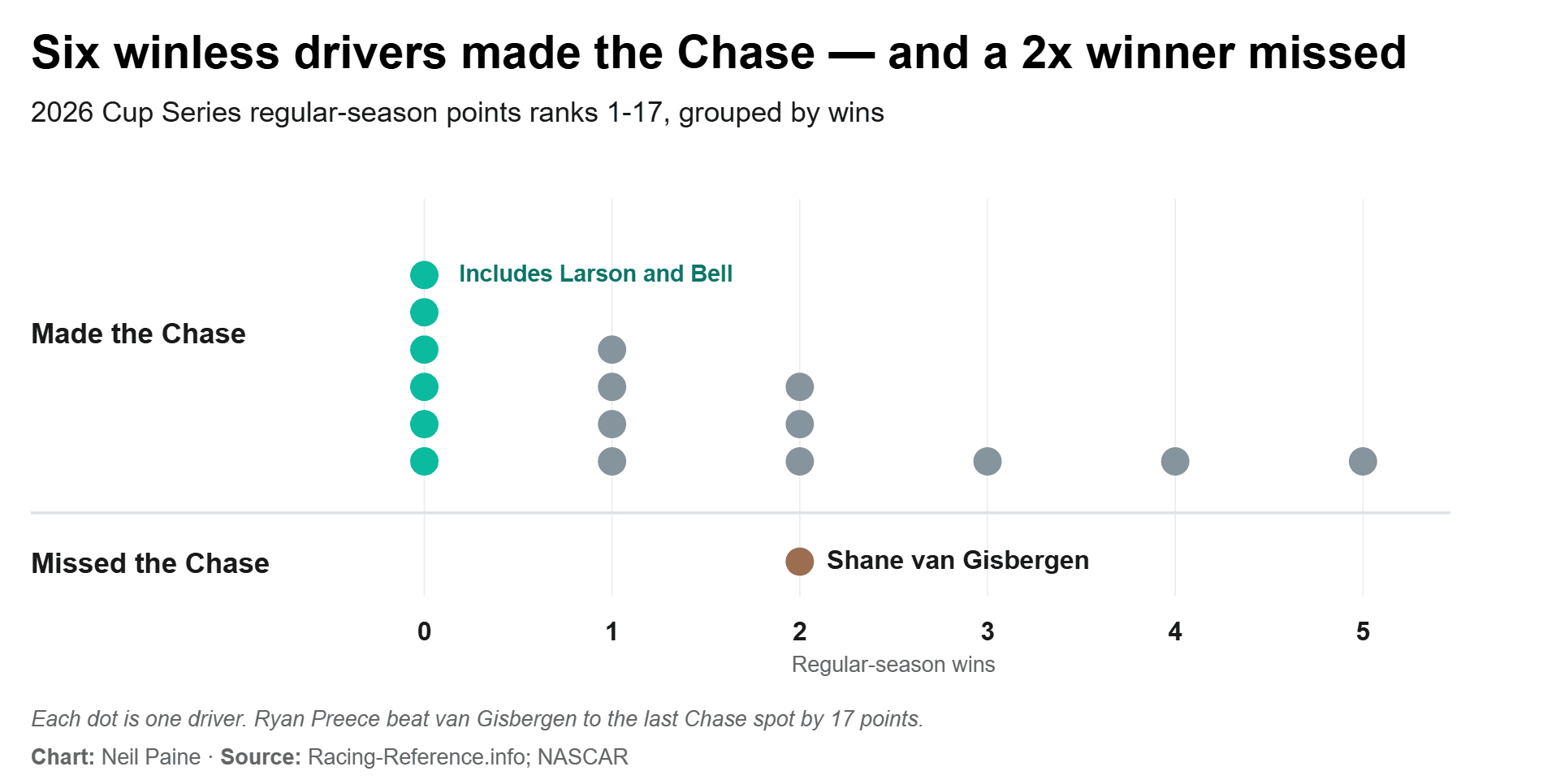
Obviously, the headline change for the entire 2026 season was the reintroduction of The Chase presented by Mobil 1, and with it came new dynamics that drivers, teams, and fans alike had to adjust to on the fly. For instance, the elimination of win-and-in postseason qualification put more emphasis on regular-season consistency than a high ceiling — which came back to bite Shane van Gisbergen, who won 2 races but missed the final Chase spot … while 6 different winless drivers (including Larson!) made The Chase instead. Contrary to what Vince Lombardi would have you believe, winning wasn’t the only thing that mattered this NASCAR season.
At the same time, the 15 bonus points for a win (compared with 2025) still put checkered flags at a premium. We saw this in The Chase both as Larson built his lead in the middle of the proceedings, but also when he had a late-Chase scare at Phoenix Raceway, which seemed to open the door for other rivals. While Larson slammed the door quickly thereafter with another W at Talladega Superspeedway, the perception that Larson ran away with a drama-free title isn’t really correct — he had to perform even after his hot Chase start to earn the championship.
Kyle Busch left an unforgettable impact on the sport.
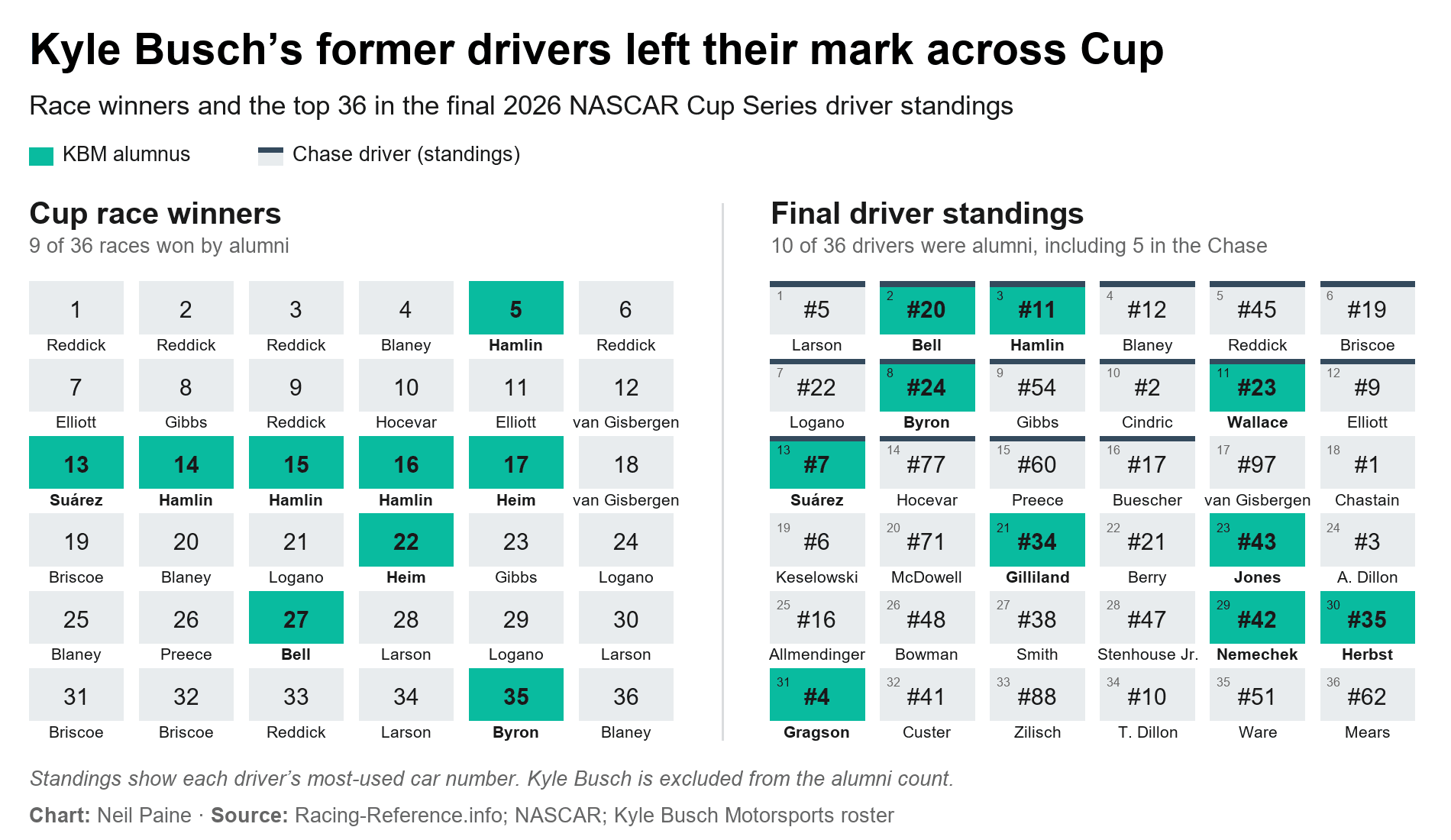
The most shocking and tragic development of the 2026 season, by far, was the death of Kyle Busch at age 41 in late May. It remains a difficult thing to comprehend, and the sport spent the rest of the season honoring Busch with a Lap 8 salute at each race to remember the legend of one of NASCAR’s greatest winners. But Busch’s fingerprints were all over the season in other ways, too.
As we wrote in the wake of his death, one of the underappreciated aspects of “Rowdy” ‘s legacy was as a team owner with Kyle Busch Motorsports, where he played a role in the careers of countless drivers in the NASCAR O’Reilly Auto Parts Series, NASCAR Craftsman Truck Series and ARCA Menards Series over the years. Nine Cup races were won this season by drivers who’d previously driven for KBM, and 10 regular Cup drivers were in that category — including 5 in The Chase. Busch was also honored posthumously with NASCAR’s Most Popular Driver Award at NASCAR’s postseason awards ceremony, with his wife Samantha accepting the award on his behalf.
Tyler Reddick showed that even the hottest of streaks isn’t enough.
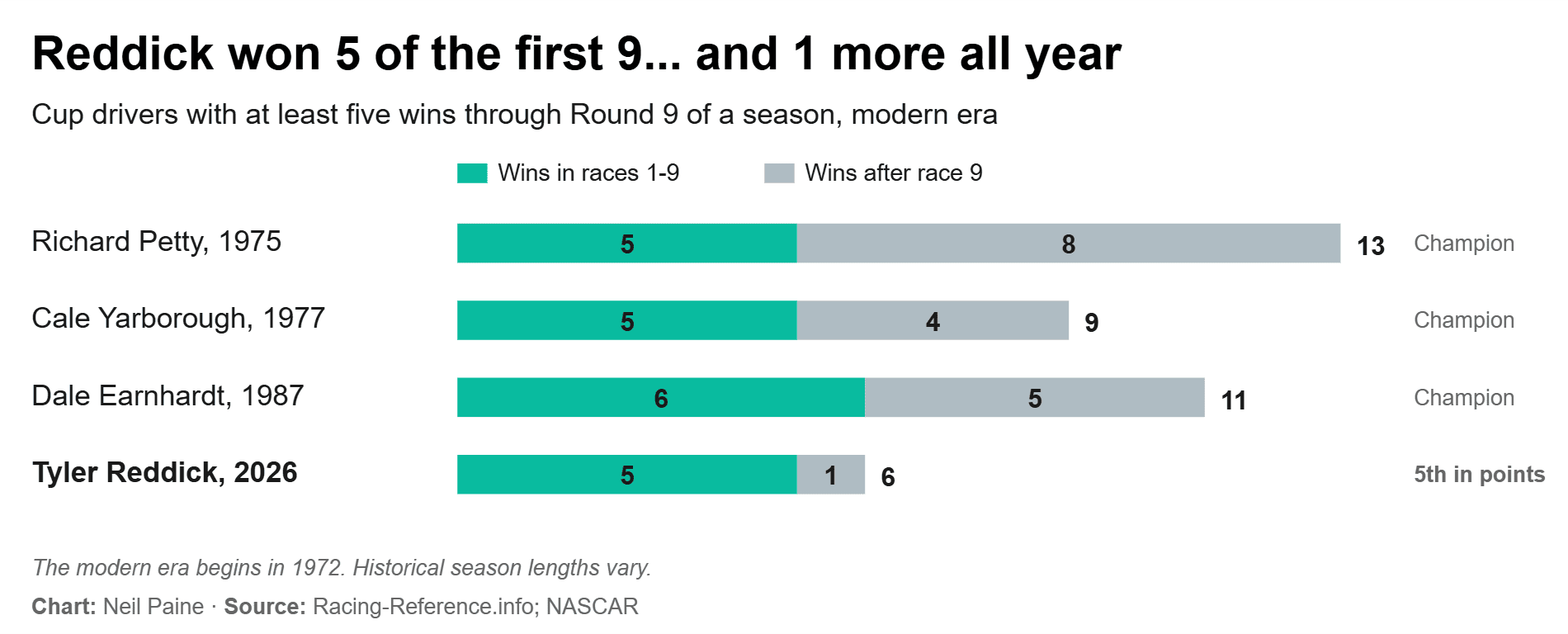
The defining early-season narrative of 2026 was the historic dominance of Tyler Reddick, who won the season-opening Daytona 500 and then proceeded to rattle off two more consecutive wins — becoming the first driver ever to sweep the first three races of a season — en route to five wins in the first nine races of the year. At that point, it was difficult to envision how Reddick would ever lose a race, much less lose his grip on the No. 1 seed in The Chase.
And yet, that’s exactly what happened. Within the span of just another nine races, Reddick had ceded the top spot in the standings to Hamlin, and he’d never get it back. While he got within 24 points of the leader (Hamlin) after Darlington Raceway, (The Chase opener), Reddick was still only fourth in the standings then and never climbed closer in the points — even after winning again at Phoenix in the fourth-to-last race of the season. The lesson was that, in one of the longest and most grueling seasons in all of sports, even a hot streak unlike anything NASCAR had ever seen before isn’t enough to guarantee you the top spot in the standings, much less a championship — especially when it comes so front-loaded in the schedule.
The future of NASCAR is upon us.
In some ways, the Cup Series is in the middle of a transitional period of generational warfare. Drivers in their thirties won 26 of 36 races (72.2%), which tied 2014 for the most such victories in a season since 1977. Six drivers specifically aged between 30-33 — Larson, Reddick, Christopher Bell, Chase Briscoe, Ryan Blaney and Chase Elliott — won more than half the schedule, combining for 19 total victories. (Hamlin, meanwhile, carried the entire 40-and-over contingent; he claimed all 4 victories by a driver aged 40 or older.)
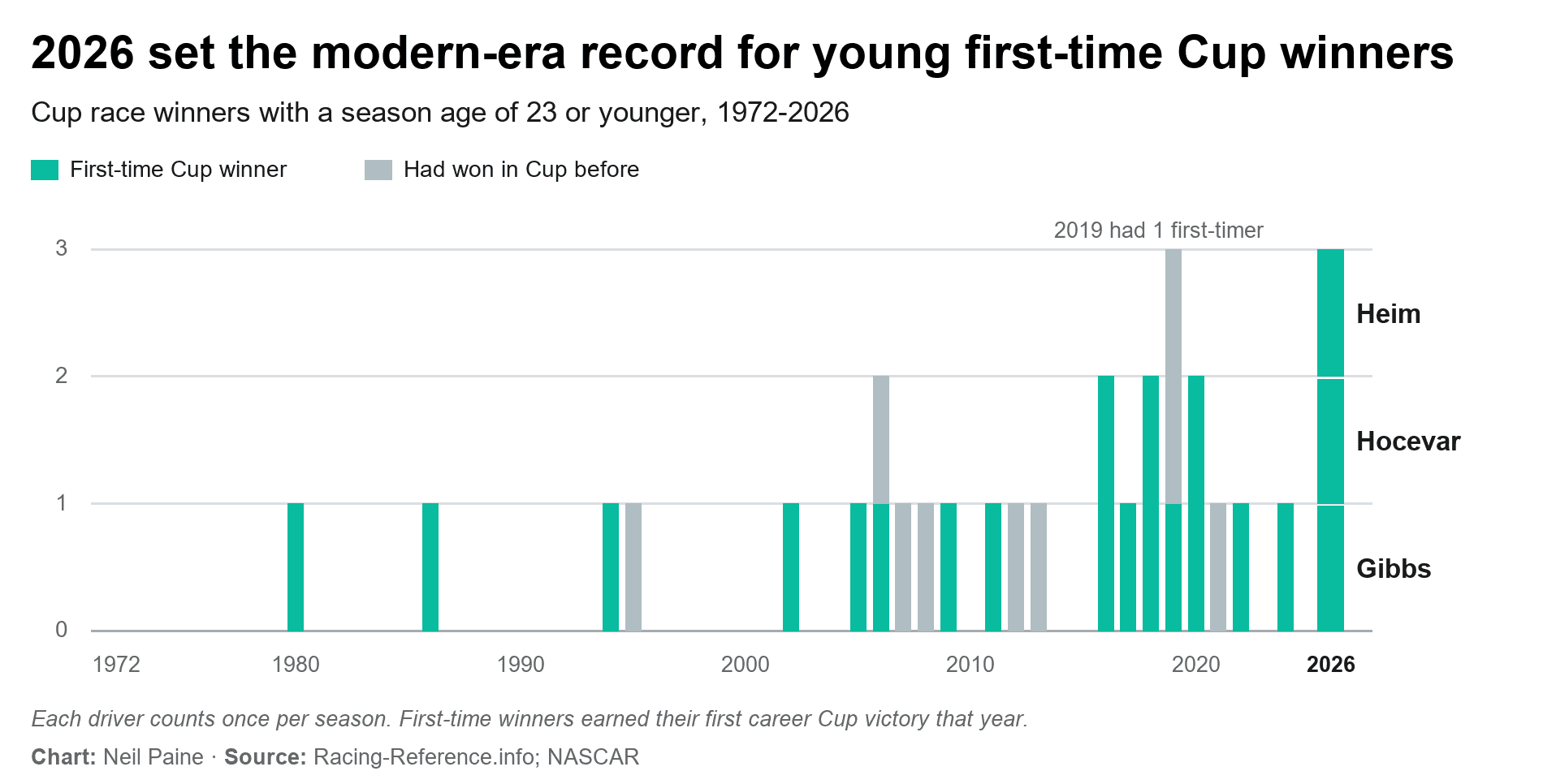
At the same time, a trio of 23-year-olds — Ty Gibbs, Carson Hocevar and Corey Heim — each became first-time winners, making 2026 the first modern-era season with three first-time winners aged 23 or younger. Both trends will probably continue to collide next season: Reddick, Elliott, Bell, Briscoe, Blaney and Larson will still be under 35, while the young-guns contingent could get further support from 22-year-old Jesse Love joining the full-timers for Wood Brothers Racing and 20-year-old Connor Zilisch presumably improving on a challenging rookie Cup campaign. (No, we haven’t forgotten the historic potential Zilisch flashed earlier in his career.) So it’s fair to say the battle between NASCAR’s prime-age stars and the next generation is only just beginning.
WATCH: NASCAR video highlights