Bill Janitz kind of knew. The first impression that Kyle Busch made on him that November morning gave him that hunch.
Janitz, Busch’s longtime public-relations rep, had orchestrated his driver’s weekend schedule for years, with pre-race engagements thoroughly planned down to the minute. Busch liked things organized. If there was a lapse in preparation, Janitz said Busch would let you know.
So Janitz made sure things were just so, to avoid the disruptions that could throw off a whole weekend’s rhythm. Busch’s schedule of events was shared through iCloud to their phones, but the two also kept a pair of hard-copy duplicates with line-by-line listings all color-coded by category — driver appearances, sponsor meet-and-greets, media events, all the way up to the drivers’ meeting and pre-race ceremonies. For most race weekends, Janitz said that schedule could fit on one sheet. But heading into the season-ending weekend in 2019 at Homestead-Miami Speedway, that schedule was packed with extra trimmings that spanned multiple ruled pages — volume rivaled only by the Daytona 500 in its extensiveness.
WATCH: Classics: 2019 Homestead-Miami replay
Busch was making his fifth consecutive appearance among the championship-eligible final four, so the extra Homestead hullabaloo was almost second nature by that point. But amid all the frantic fanfare, the buzzy add-ons and obligations that created one of the season’s biggest pre-race swirls, the aura that Kyle Busch projected upon Janitz’s arrival to his motorcoach in the 10 a.m. hour was that of sharply focused serenity.
“It was funny because over the years, in general, you could kind of tell within 30 seconds of him walking out of that bus in the morning for us to go to our hospitality visits, I kind of knew where his head was at. I could tell when he felt like he had a race-winning car,” said Janitz, who paired with Busch from his arrival at Joe Gibbs Racing in 2008 until his departure after the 2022 season. “Now that didn’t always turn out to be the case because it’s racing and things happen that are beyond his control, but I think you know when he went through practice and qualifying and everything during the weekend and the adjustments that they made, I think he always, he had this feel to him. He’d walk out of the bus, and I guess I would best describe it as a calmness — not overly happy, not overly upset. Just kind of this calmness to him that I would see, and you would kind of go, ‘All right, he’s going to have a chance to win today.’ “
NASCAR’s championship weekend makes its return to Homestead-Miami this weekend, wrapping up an eventful first go-round with the new-look Chase presented by Mobil 1. The revival of the south Florida venue as the host track for a tripleheader of season finales has prompted remembrances and fits of nostalgia for the classic crowning moments that have unfolded through the years inside its pale blue walls. Those memories overlap with what’s been a lasting celebration of life this year for the late Kyle Busch, who hoisted the Bill France Cup for the second time in his career the last time Homestead hosted the season-long championship fight.
The story of Busch’s second Cup Series championship was a journey of redemption, perseverance through adversity and brilliant execution from a team and driver who shared an elite-level determination. It marked not just another chapter in Homestead’s rich history, but another top-shelf entry in Busch’s long list of racing achievements.
A locked-in sense of calm amid all the fanfare helped show the way.
* * *
The 2019 season was easily one of Joe Gibbs Racing’s most successful — 19 victories in 36 races, a second Daytona 500 win for Denny Hamlin and Busch’s clincher at Homestead that year. But a deep sense of loss weighed on the organization from the outset.
J.D. Gibbs, the eldest of Coach Joe Gibbs’ two sons and a beloved JGR executive, died that January after years of cognitive decline. His influence as team president and later co-chairman was instrumental in the organization’s growth, especially when his father returned to the NFL for a late-career coaching stint. But he was best remembered by colleagues for his kindness and the way he treated others.
“There wasn’t a corner or room or office of this shop that he wasn’t in every day or every other day, checking on every single person, knowing everybody’s name, knowing something about them and recognizing the work that everybody puts in — not just the drivers, not just the crew chiefs, not just the people that travel,” says Adam Stevens, who served as crew chief for Busch’s No. 18 that year and now sits atop the pit box for Christopher Bell’s No. 20 JGR Toyota. “But he knew how important everybody’s job was to the ultimate goal, and it was completely genuine, and he would go out of his way to stop you and thank you for the job you were doing and how hard you were working, whether it was a good weekend or a crappy weekend.
“I can’t tell you how many times I bumped into him right outside that door going home, and it was like he was standing there waiting on me, you know what I mean, just to put his arm around me and say thanks. Just a tremendous impact on the shape of this company and the way that we all try to run it.”
Hamlin’s Daytona triumph gave the organization a bittersweet moment to remember Gibbs’ impact, but his enduring spirit was celebrated throughout the 2019 campaign.
“There was definitely an angel driving with us throughout the year, and faith would make me think that he had a big impact on what was going on that year, but I think it was more of the legacy of the things that he had set up and the people that he had put in place,” said Matthew Tyrrell, the fueler then for Busch’s No. 18 who now serves as the gasman for the JGR No. 19 and driver Chase Briscoe. “So I think J.D.’s legacy was more how he treated people and the machine that he set up that was able to be successful even without him being here, and then I do feel like he was with us at the time as well.”
Compounding those hardships was a more personal family issue. Kyle and his wife, Samantha, had long been open about their struggles with fertility. The couple were overjoyed to welcome their son, Brexton, into the world in 2015 — the same year as Busch’s first Cup title — but their desire for a second child four years later were left unmet, with Busch emotionally noting in his champion’s speech later that year how the family had endured multiple setbacks.
It was under that context that Busch navigated the 2019 season, both as a driver and the owner of a successful Craftsman Truck Series operation.
“I think it weighed a ton on him,” Janitz says. “They obviously so badly wanted to have a second child, and obviously it was really exciting when they were able to have Brexton and they wanted to have a child again. I can’t even imagine what it’s like and how frustrating that could be and so yeah, I think he’d be lying if he said it didn’t permeate into other parts of your life. So I think one thing that he did do a good job of is, again, once he got to the race track, put on the helmet, he was able to focus on what was going on there. But I think that was very difficult for them.
MORE: Weekend schedule: Homestead | All of Kyle Busch’s Cup Series wins
“I felt for them. I think Samantha did a really nice job of being transparent and telling people what they were going through. Not many people get a peek behind the curtain like they gave people, but I think they also felt like there’s a lot of other people in this world kind of going through the same thing, and maybe that’s going to help someone else.”
Stevens, who worked with Busch for six seasons from 2015-20, saw the impact firsthand.
“I think that was a lot of the mental capacity and his ability to navigate adversity, I think, was diminished for a portion of the season because he had a very, very full plate with KBM (Kyle Busch Motorsports), with the foundations he was in and everything that he was involved with,” Stevens says. “Then to put you know some of that family struggle on top of it, it definitely had him in a little bit different headspace for a portion of the year, and the sum total of all of that was weighing him down and somehow or another, when the playoffs came around, kind of talking about that, his ability to increase his intensity and his focus, he was able to put some of those things aside.”
The extracurricular burdens — both public and private — didn’t show in Busch’s early on-track efforts. He grabbed the Cup Series points lead with a win in the fourth race of season at Phoenix, then went back-to-back with another dominant victory the next week at Auto Club Speedway. Later that spring, Busch added another tally to his Bristol bounty before taming Pocono’s triangle for his series-leading fourth win by that point.
Those results, however, began to tail off, just as the competitors who would join him in the Championship 4 field that year — Hamlin, fellow JGR driver Martin Truex Jr. and Stewart-Haas Racing veteran Kevin Harvick — made significant strides. Busch’s losing streak eventually reached 21 races heading into Homestead-Miami, but his steady nature and stature as the postseason’s top seed helped him advance through the rounds of the elimination-style format.
“Coming into the playoffs, I would say the last stretch of the summer, results got cold and a little bit up and down, and we didn’t come in there with what we felt like was a lot of momentum,” Stevens said. “… But you know, we were really good as a team and as a combo of not sticking our necks out too far, and just base-hitting that thing as far as it would go, and then when you needed a double, you tried for a double. You didn’t try for a triple. You weren’t swinging for the fence, and if there were times we needed to swing for the fence, we swung for the fence. But we were always able to progress through the rounds for five straight years and put ourselves in a position to make it to that final four. Then when you made it to Homestead, it’s a whole different ballgame again.”
Said Janitz: “I think he fed off of winning and momentum, definitely more than I feel like some other guys do. For him to kind of stay in the game, I guess, throughout that year was something probably he couldn’t have done very well in the early part of his career, but something that he learned as his career went on. Certainly, I think what he went through in 2015 sort of changed the game for him when it came to being able to face some adversity and not let it go the wrong direction on him.”
Recapturing the groove from the early season show of strength also boiled down to how Busch responded to pressure when it mattered most. The timing was right.
“The thing that always impressed me the most about KB was when the playoffs started, he always had another gear, and the amount of focus and mental toughness that he could drum up when it was time is like something I’ve still never seen. It was remarkable, and that intensity would only ramp up as the playoffs went,” Stevens said, noting how regular-season defeats were sometimes slightly easier for Busch to accept. “In the playoffs, it was just an intense level of focus and intensity, and just measured and calculated moves on his part, and I think it was so intense that it was probably something that a normal human couldn’t maintain for a whole season. So he kind of bottled it up and always saved it for the playoffs.”
* * *
Though Busch was the face of the team and was by then well-established as a polarizing figure in the court of fan opinion, the supporting cast of the No. 18 group was just as fundamental to making their colorful M&M’s car go.
The chemistry was one thing, but the high-grade performance made it a more perfect match.
“Oh, it was insane how well we fit together,” says Tyrrell, now midway through his second decade of going over the wall for Joe Gibbs Racing. “That’s by far, I think this is my 19th season in the sport, and that group stands out head and shoulders above every other one that I’ve ever been a part of. Just from the get-go, all five of us were just, we clicked. Three or four of us had previously worked together and were reunited, so I think that was part of it, but you know, performance and achievements all lined up with our personalities, and we knew how to keep each other accountable and just how to push each other, how to push each other’s buttons — right and wrong — but it was that dynamic that like was able to keep us going and pushing.”
Stevens also had new cogs in place in the No. 18 team’s engineering staff. Ben Beshore had left his role as the lead race engineer to become a crew chief in JGR’s O’Reilly Auto Parts Series program, winning four times in seven races with Busch that year. In stepped Tyler Allen, now the crew chief for Ty Gibbs’ No. 54 Toy0ta, with William Hartman as part of the engineering staff’s support. Two years of working with Stevens had made their workflow and communications a smooth process. “But I was green,” Allen said, “and then we had William come on board as a second engineer, also very green, so there was some learning curve early in the year to get up to snuff.”
MORE: Watch NASCAR video highlights
That easing-in process was made more challenging by major life events for Allen and his family. His son, Riley, was born Nov. 7 of that year, just before the next-to-last race of the season at Phoenix. Allen took a brief paternity leave and worked remotely on a lighter schedule, but returned to the track for Homestead, with Stevens welcoming his return.
“We worked together for quite a few years, and that’s not a puzzle piece that you can just pull out and find the exact same shape puzzle piece to put back in,” Stevens says. “So there’s always a transition when you have turnover in a high-level position like that, and certainly thankful to get him back when we did when it really mattered.”
There may have been a slight underdog vibe to Busch’s title bid. Besides the lengthy drought pre-Homestead, his JGR teammates entered the finale with more wins that season — Truex seven and Hamlin six.
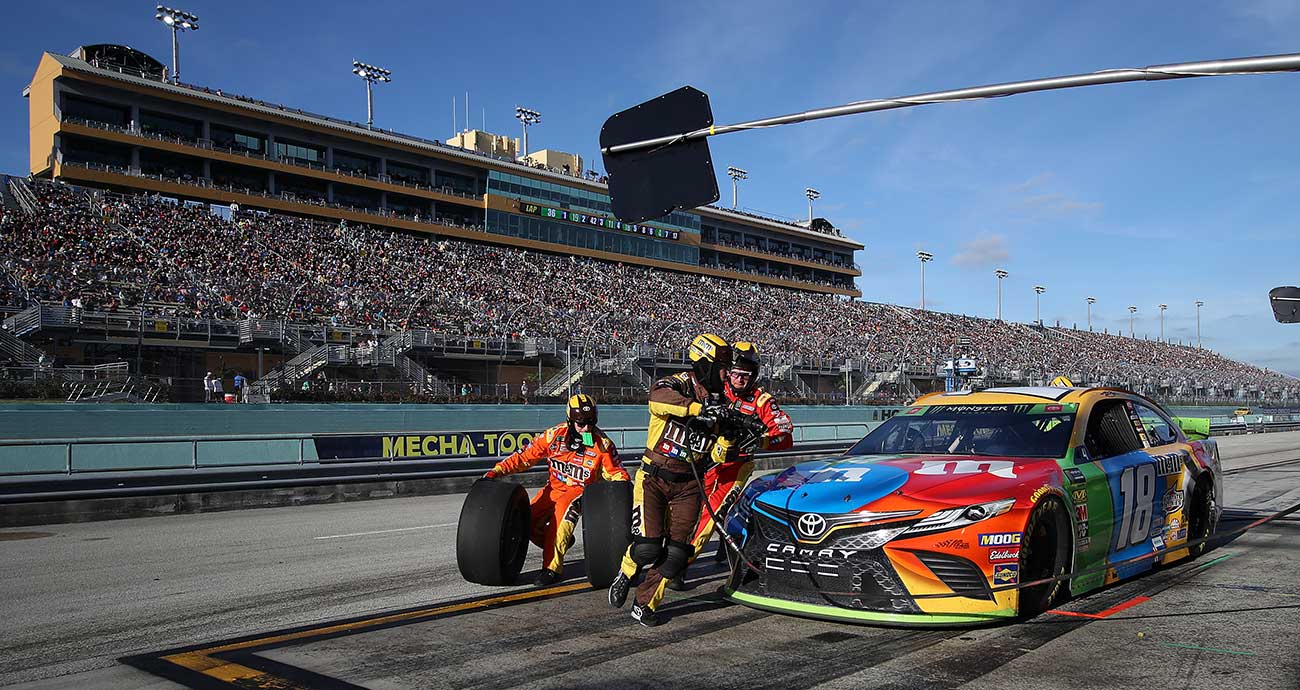
Along pit road, however, there was no seeming disadvantage. The No. 18 crew — Tyrrell, TJ Ford (jack), Camron Waugh (front tire changer), Joe Crossen (tire carrier) and Jeff Cordero (rear changer) — produced the fastest four-tire stop in 13 of the 36 races that season, six more than the next-best efforts of the No. 9 Hendrick Motorsports bunch. Three of those series-topping performances came in wins by Busch, including at Homestead, and the No. 18 crew improved upon their season-long average come playoff time.
“Maybe from a car/driver standpoint we were the underdogs, but I don’t think at any point in time, like the internal confidence and momentum that we had as a pit crew was like the polar opposite,” Tyrrell said. “We knew we were the tool that was going to make a difference, and so we were beyond excited. I don’t think that we used it as motivation, but like we had internal confidence throughout the course of that year, that just it didn’t matter what was going on. We knew we were going to be able to put them in contention.”
Some of that motivation stemmed from “Rowdy” himself.
“I think as a group, we all kind of followed KB’s lead in our preparation and how we ran the whole season, goal No. 1: win the championship. Everything else that happened between the Daytona 500 and Homestead was a stepping stone to reach that goal, and that’s how we all operated,” Stevens says. “Everybody tried to be at their absolute best once the playoffs started, with the goal of advancing through each round and getting into Homestead and winning that race. They worked toward that goal and made sure that mentally and physically and as a team preparation-wise over the wall that they were peaking at the right time.”
* * *
That year’s season-ending broadcast featured bite-sized interviews from each driver in the championship-eligible quartet, with vignettes shown in the pre-race run-up to the green flag. Busch’s outlook: “2015, we weren’t a favorite. We’re not a favorite this time. If we’re good enough, then we’ll be crowned at the end of the day.”
Busch’s callback to his first Cup Series crown was intentional. That season was abbreviated by injury after a crash in the season-opening O’Reilly Series race at Daytona that sidelined him for the first 11 races of 2015. The road back to competition and fine health was a long one, and NASCAR officials granted Busch a medical waiver to restore his postseason eligibility.
Though Busch powered to four-regular season wins in quick succession that summer and capped off his first title with his first Homestead victory, his accomplishment had its detractors. “There’s a lot of doubters from the first one,” Busch said later in the broadcast, “so obviously that would help that.” Four years later, it was a point that Busch had an opportunity to prove in the winner-take-all finale.
“He definitely wanted to show that he could do it without the waiver,” Janitz says. “If you saw what we all saw with how he worked so hard to get back, and then how focused and how hard they worked to get back in the championship fight in 2015, I think fans would appreciate it. I feel like and he felt like he was a worthy champion, but yeah, he wanted to prove it again. He had a lot of other shots, right? And so to be able to win one and not have people come up with something that questioned it, I guess. In his mind, he didn’t question it, but it was a big deal for him. …
“He definitely wanted to prove people wrong every day. It wasn’t just in that case, but yeah, he wanted to show that he could do it and people didn’t put an asterisk on it for him. I don’t think he felt it was an asterisk at all.”
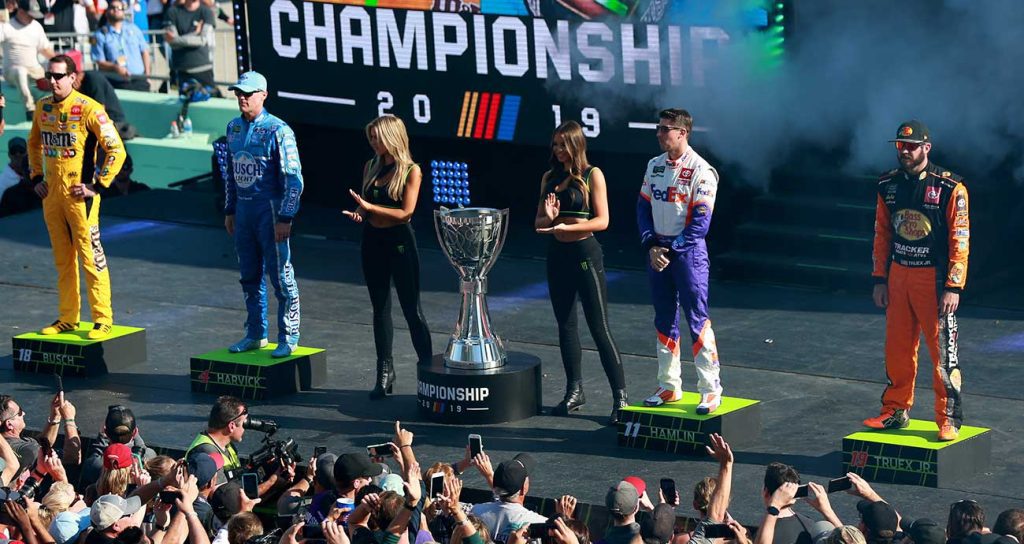
Standing in between him were 267 laps and a formidable trio of fellow veterans, each of whom took turns leading in the early going. Stevens had set up Busch’s car knowing that the No. 18 Toyota might sacrifice an initial advantage with the hopes that it would come alive as the warm Florida set. It was a trade-off worth making, but the finale hinged on which teams would slip up first.
The first to crack was JGR’s No. 19 group, which mixed up its tires — right-sides bolted on the left and vice versa — during a Lap 121 stop, prompting Truex to make a second, unplanned trip down pit road. The No. 11 team faltered next, sealing off its grille with too much tape in a final-stage stop for service, forcing Hamlin to pit from third place with overheating issues and dimming his chances. Harvick and the No. 4 bunch were the last to fade, as his SHR crew opted for an off-sequence strategy of running long in the final stage, hoping for a caution flag that never came. The closest the No. 18 came to an unforced error happened early, with Busch nearly crossing too many pit boxes on his approach as he battled the afternoon sun’s glare over Turn 1.
“That doesn’t always happen,” Allen said. “I mean, I was hyper-aware of the mistakes that the other teams were making, and you almost get a sense of relief. You’re like, ‘OK, we just need a smooth day.””
Busch & Co. found one on pit road. These were the days when five lug nuts were used to fasten wheels, and the No. 18 crew eclipsed the 12-second threshold twice in the Homestead finale. Across the whole series, sub-12s had only occurred seven times all season, and five of those lightning-fast stops belonged to the No. 18 crew, which had reason to celebrate after its final stop on Lap 211 helped Busch cycle back to the front.
“There was almost a second disparity between the pit stops we were putting Kyle out at and what like second and third place were doing,” Tyrrell says. “Like it wasn’t just a barely beat. It was like stomping the competition difference-wise. So, again, confidence just from stop to stop. We had a year’s worth of history that we knew we could do it. So, like I think going into it with confidence, but yeah, I mean, pure elation that you can do it when it counts and make a difference in a race.”
MORE: Post-race reactions: No. 18 crew
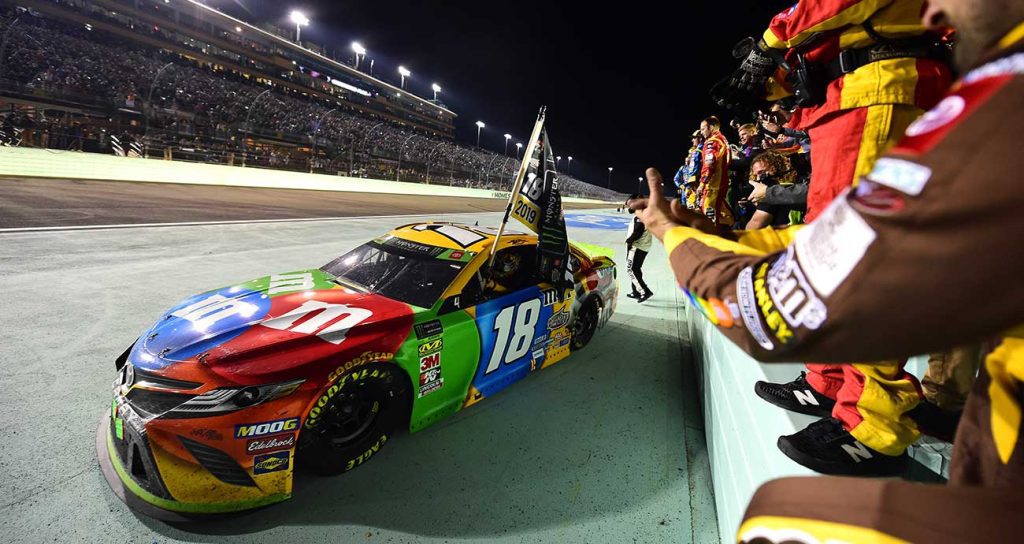
Busch crossed the line nearly four and a half seconds clear of Truex, the runner-up for the second consecutive year, and the celebration began in earnest. “Ol’ two-timer out there. Proud of you, buddy,” Stevens said over the No. 18 radio after the checkered flag.
Stevens smiles now when reflecting on the race-day execution. “I think we had the day that everybody was trying to have.”
* * *
Knowing that his No. 18 ride would soon come under post-race inspection scrutiny, Kyle Busch turned to a NASCAR official and asked for permission. He wanted to give his son, Brexton, a passenger-seat ride around the 1.5-mile track before the confetti and champagne in Victory Lane, and was fearful of letting anyone else — even his own kin — touch the car.
Brexton Busch had been born just six months before his father’s first Cup Series title, but now as a wide-eyed 4-year-old, he was able to soak in and comprehend one of his family’s cherished moments.
“I think he really was proud and excited to be able to experience that not only with Samantha but with Brexton,” Janitz says. “You know, it kind of chokes you up a little bit now to think about it because that was the neatest part of that day even back then, and to think about obviously what’s transpired here in the last year. Those moments and what happened post-race and Brexton being able to get to ride in the car and do all those things after the race are even bigger, right? It’s even a bigger deal.”
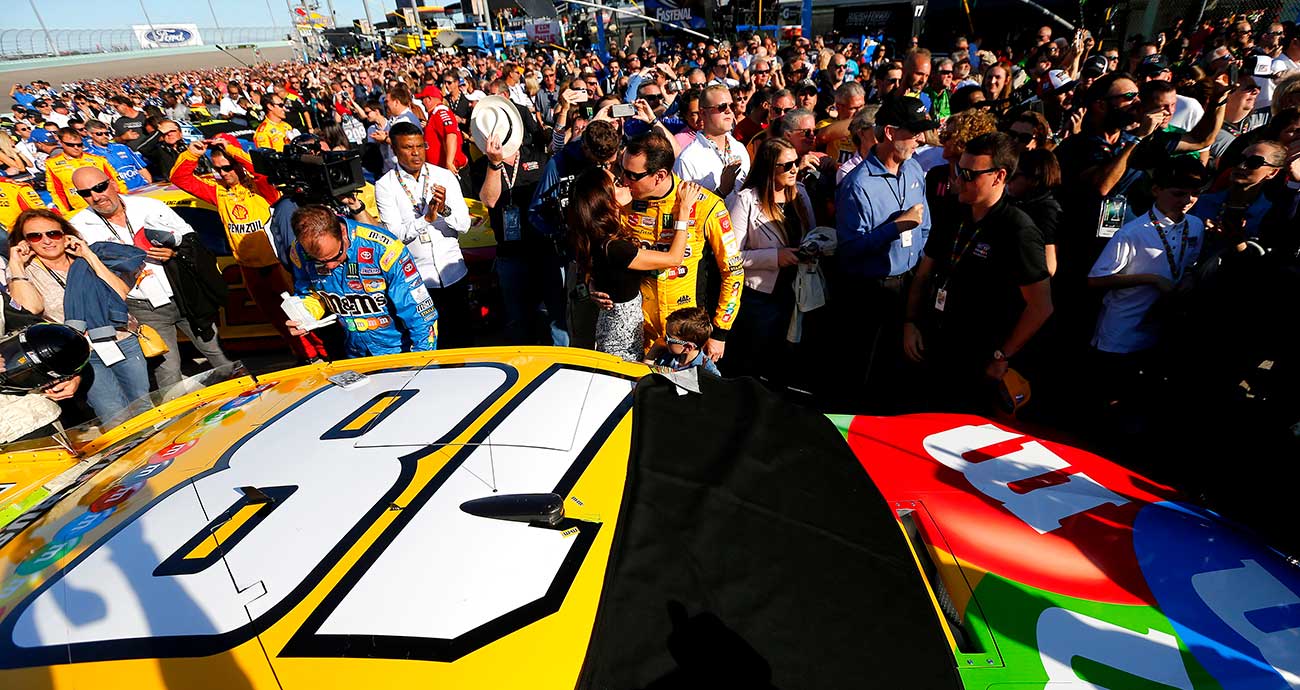
Post-race was a mob scene. Allen recalled the sea of people and the difficulty he had in reaching his crew on the frontstretch. Tyrrell recalled pausing to take a breath and wait a beat, heeding the advice of Ford, the team’s jack man, to savor it all.
“You don’t know when, how, if you’re ever going to come across that scenario again, whether it’s a truck win with Kyle that season or whether it was a championship,” Tyrrell says, “and so I think just really taking a moment to reflect on everything and just try to take in all the sights, sounds, smells, like just to burn that into your memory, I guess, and just really enjoy the moment. So I feel like I did a good job at that time of just taking it all in and just observing the surroundings, and it’s a special memory that I have now.”
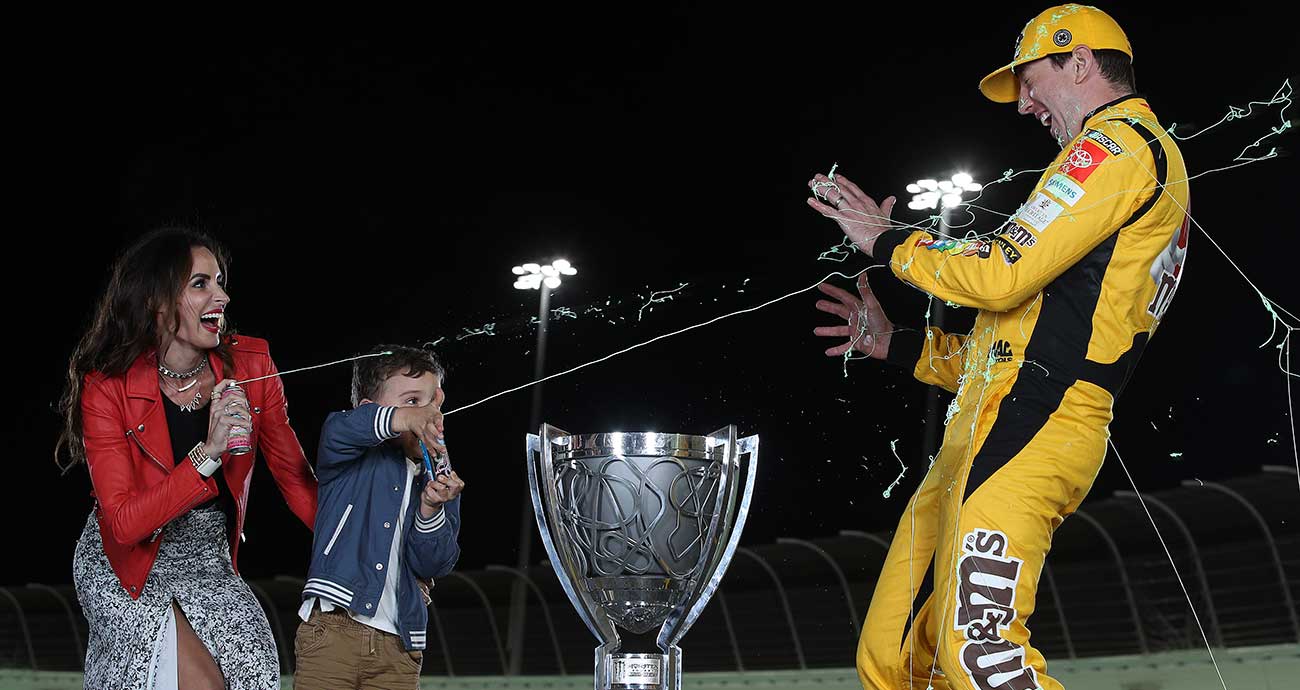
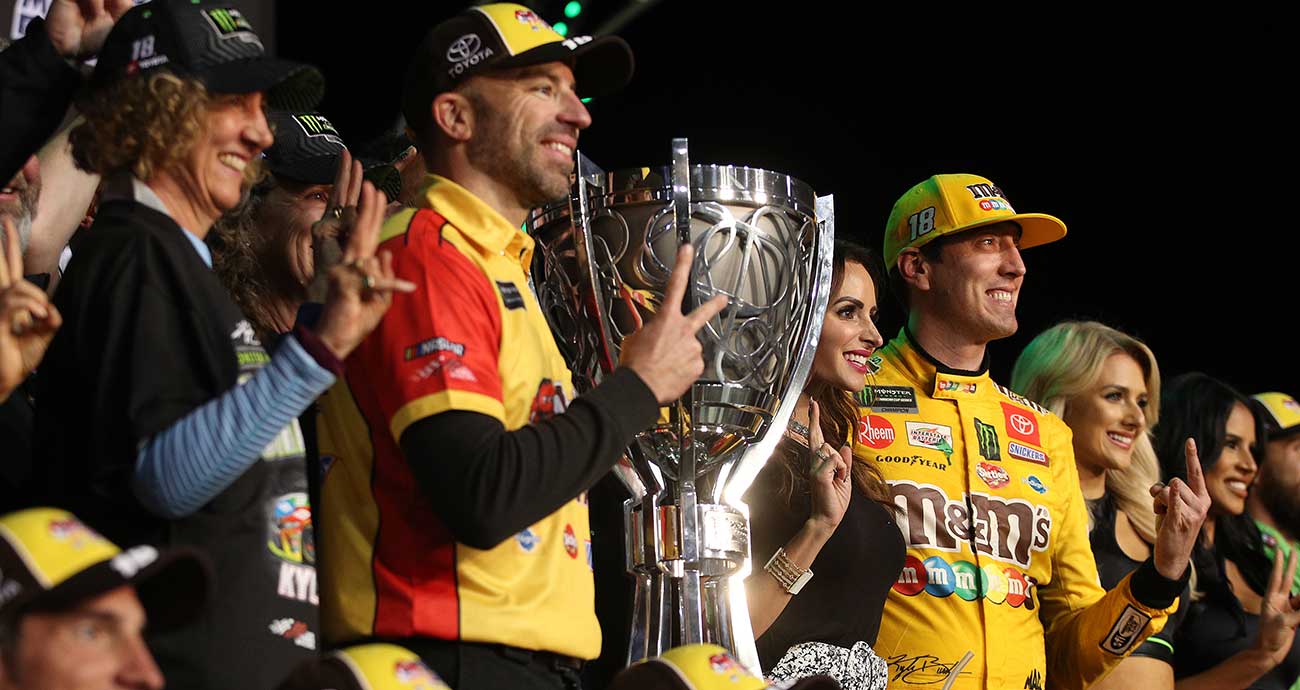
The lines in Janitz’s day planner didn’t run out until nearly 1 a.m. Monday morning, after all the post-race obligations. The Busch family posed for photos on the track with the Bill France Cup, with Brexton standing tall in the trophy’s basin and a silly-string battle providing a moment of levity for all three.
MORE: 2019 championship portraits
It wasn’t until later that the team was able to share a quieter moment away from the clamor, meeting outside Stevens’ bus for a smaller gathering over a cooler of beer. Janitz recalled Truex wheeling up on a golf cart to crash the celebration. “You son of a bitch!” Truex said with a wide grin, prompting a laugh and a shrug from the series’ newest champion.
“That was one of the funniest parts,” Janitz says. “Kyle was like, ‘yeah, sorry. It worked out for me today.’ … They had a lot of respect for each other, a ton of it. I think Martin came over, gave him a little bit of crap, and then obviously congratulated him. Martin’s a classy guy, and it was no surprise that he came over there.”
The discussion about Busch’s legacy has only gotten louder this year after his death from severe pneumonia and sepsis in May. The first-ballot call from the NASCAR Hall of Fame feels inevitable, and his second taste of the Cup Series crown is no small piece of his career resume.
Still, the reminders of how much more he accomplished becomes clearer just inside the front doors of Joe Gibbs Racing’s shop, where so many trophies with Busch’s name on them reside.
“Just like Superman powers out there, sometimes you just never doubted him,” Allen says. “You have an issue, he might be frustrated in the race car, never doubt him. Always in it. Just larger than life. It’s crazy to look back on his career and then to be lucky enough to be a part of so many wins and the championship is really cool.”
Homestead-Miami’s history of crowning champions will open its second stint this weekend, when Kyle Larson carries a sizable points lead over Bell and Hamlin for Sunday’s season-ending race (3 p.m. ET, NBC, HBO Max, MRN Radio, SiriusXM NASCAR Radio). It’s where Jimmie Johnson clinched all seven of his record-tying Cup titles, where Tony Stewart capped his thrilling 2011 Chase run in a tiebreaker over Carl Edwards, and where greats like Harvick, Truex, Matt Kenseth, Kurt Busch, Brad Keselowski and Joey Logano became champions for the first time.
MORE: Homestead memorable moments | Multi-time Cup Series champions
As Homestead begins its next era this weekend, the memories will coincide with honoring Busch’s contributions to the track’s last championship chapter and the sport in general. For Janitz, Stevens and the rest of the No. 18 crew, those memories will include Busch’s pre-race calm, his unflinching focus and an intimate post-race toast shared by friends and colleagues.
“Just the sense of accomplishment and relief, that we went to battle like that all year, and we were able to put ourselves in position to pull it off,” Stevens says. “Just the hard work that we all put in and the belief in each other. For those couple hours, it’s just like they’re absolutely on top of the world.”