
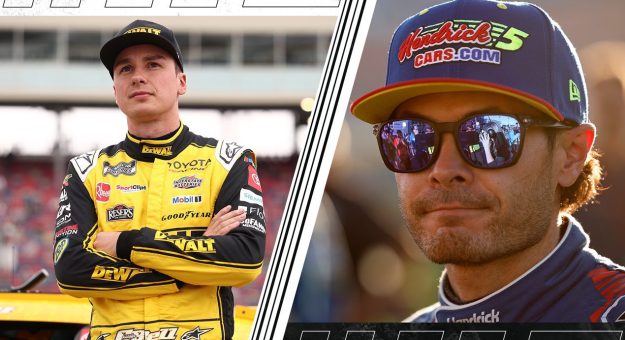
What a difference one week in the desert can make.
In this space over the past few weeks, we‘d been tracking as Kyle Larson‘s march toward a second consecutive Cup Series championship intensified with each passing race of The Chase presented by Mobil 1. Destiny seemed so clearly on Larson‘s side that, even when Chase Briscoe rattled off two consecutive wins, it actually helped Larson‘s title odds by ensuring valuable victories didn‘t go to his primary rivals in the standings. Life was good for Larson.
RELATED: Watch NASCAR video highlights
But that all came to a screeching halt this weekend in Phoenix. Larson had a rough qualifying, starting 22nd on the grid, and his team never achieved a satisfactory setup with the No. 5 car. He scored zero stage points, his average running position in the race itself ended up being just 21.98 — his seventh-worst run of the season — and that was even before a Lap 293 wreck ended his day prematurely with a 34th-place finish.
Add it up, and Larson‘s Driver Rating on the day was a miserable 49.3 — the 11th-worst drive of his career, and his worst of 2026 to date.
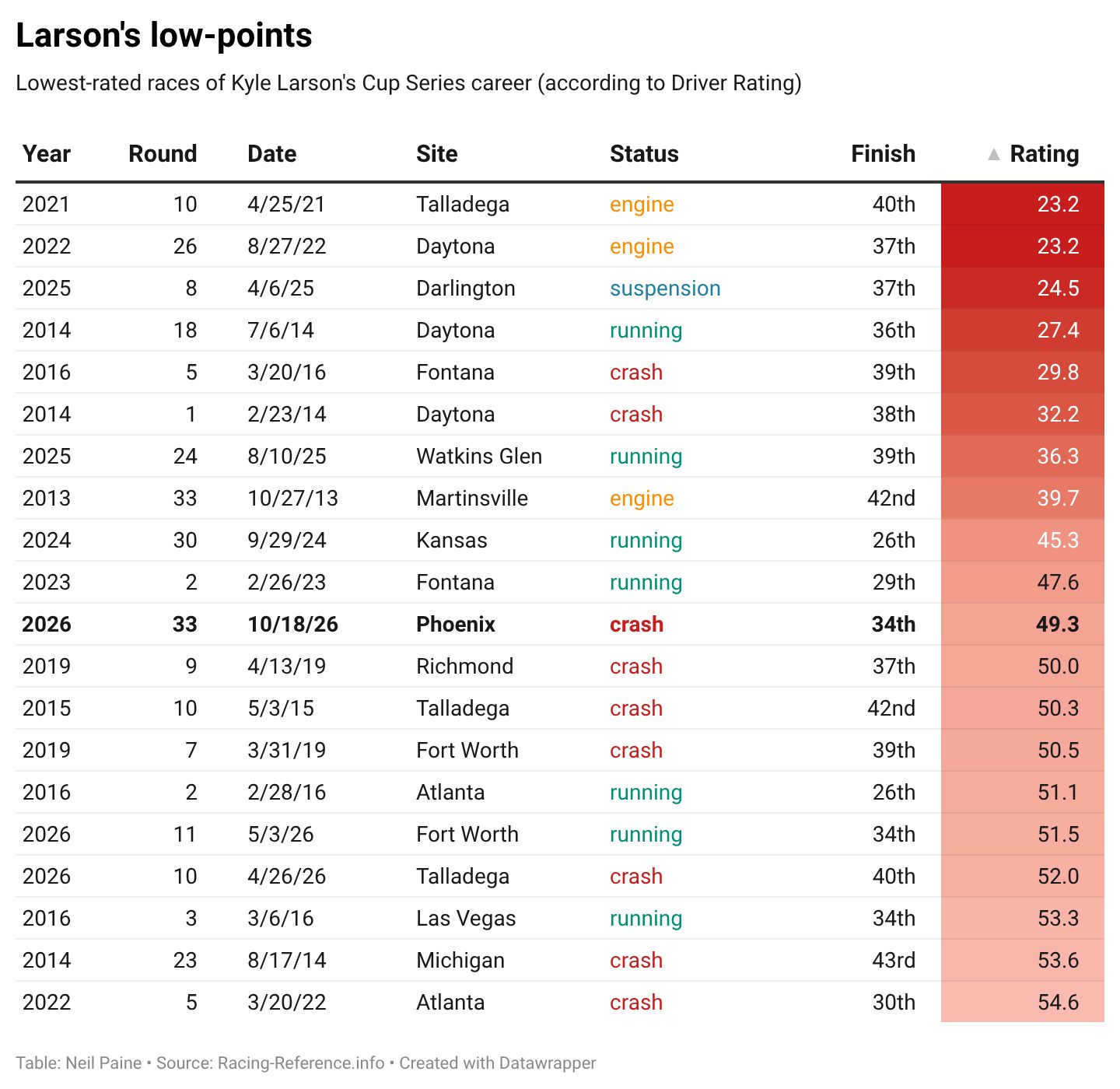
“You guys thought I was lying to you all week when I said we weren’t good here,” Larson said afterward — though, in fairness, he‘d previously finished top four four straight times at Phoenix. “I didn’t expect to be good, but I didn’t expect to be that bad, either. … We were just trying to kind of fight as much as we could and just scratch them off or whatever finish we’re gonna get.”
While he still came away with a slim points lead, it was the kind of day Larson couldn‘t really afford if so many of his top competitors were also going to do well simultaneously. (Aside from Denny Hamlin — who finished 28th but did score 12 stage points — each of the other top seven Chase drivers through Charlotte also finished eighth or better at Phoenix.) Before Sunday, only two drivers sat within 60 points of Larson; now, six do:
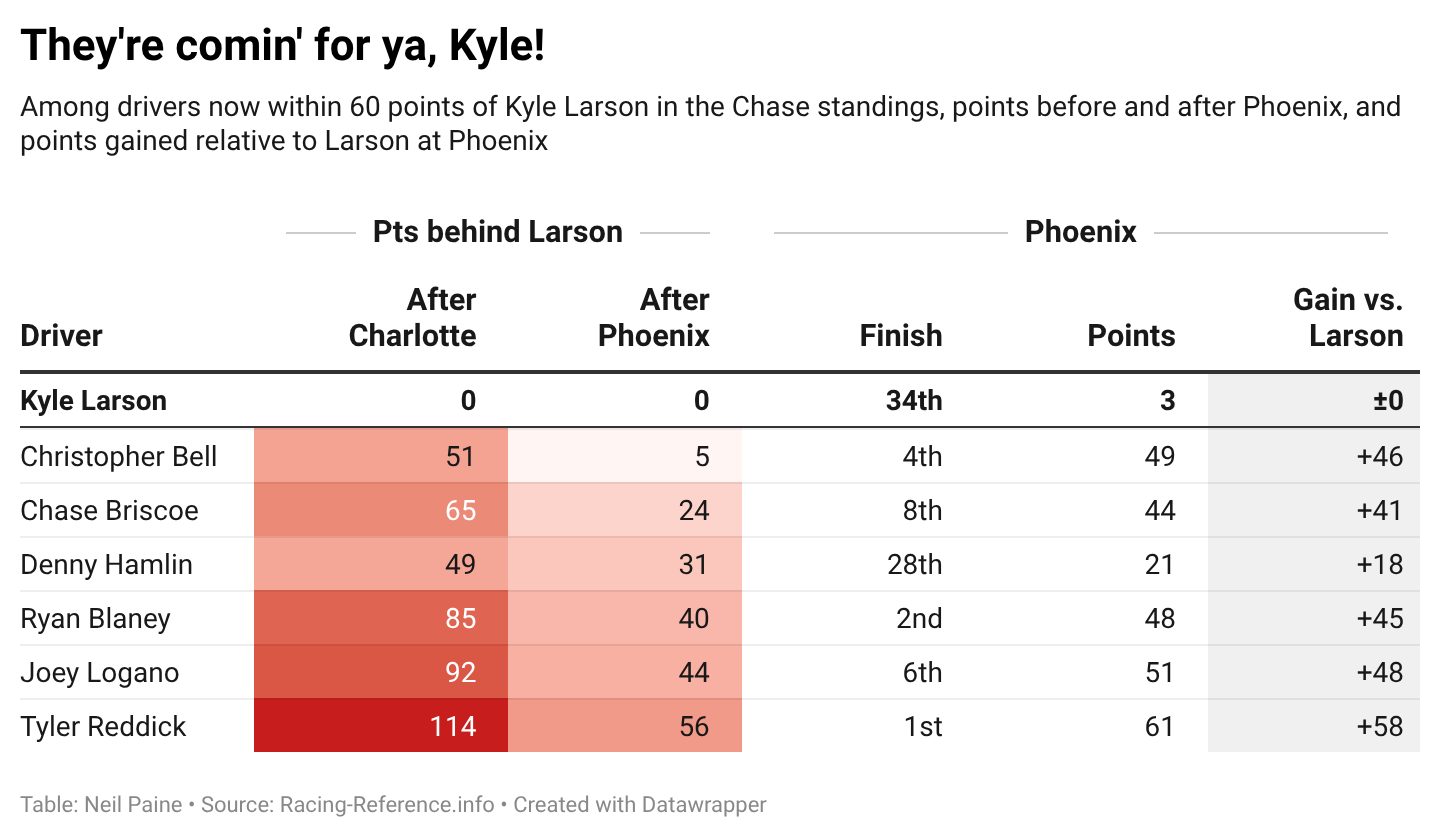
As a result, Larson‘s odds in my Cup Series championship forecast model took a massive tumble, from a commanding 72.5% (versus 10.6% for next-best Christopher Bell) coming out of Charlotte to 32.6% after Phoenix — which actually trails Bell at 35.2%! (Though Larson still sits ahead of Briscoe at 14.6%.) Suddenly, it‘s the wide-open title fight we thought Larson might just pull away from only a few weeks ago.
Bell, though, presents the greatest challenge to Larson‘s tenuous perch atop the current standings.
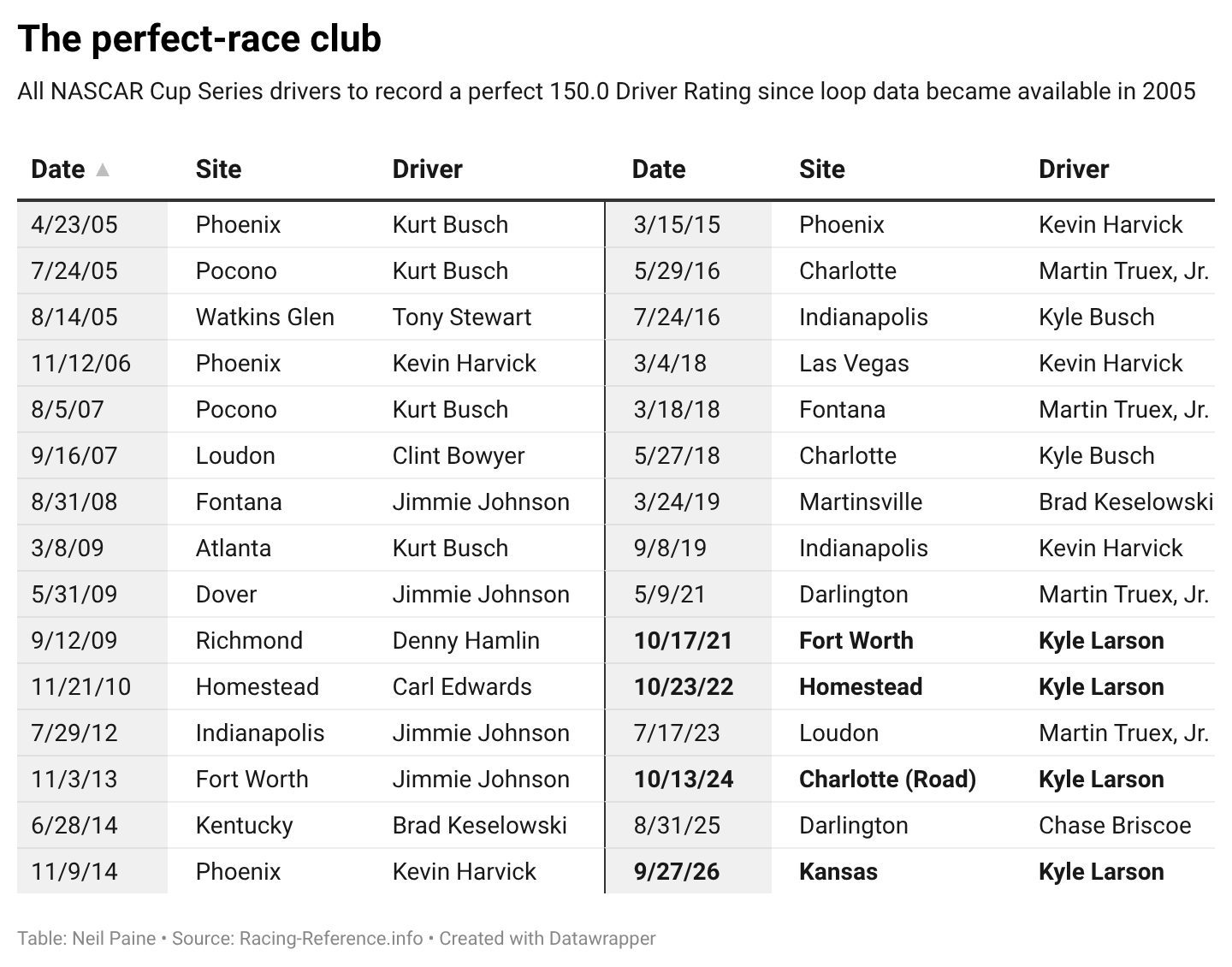
For one thing, as much conversation as we‘ve had about Larson‘s dominant start to The Chase, Bell has been better than Larson by average Driver Rating over the seven races of The Chase to date — 111.4 to 109.2 — and he‘s had the superior rating head-to-head in four of seven outings. (And that sample includes the literally perfect 150.0 rating Larson produced at Kansas.) He‘s also been better on each remaining track type — superspeedway for Talladega, short-track or flat-track for Martinsville, mile-and-a-half for Homestead-Miami — this season, all of which help explain why my forecast model has Bell slightly favored to outperform Larson at all three season-ending stops.
Of course, Larson does have the superior record on drafting tracks and especially mile-and-a-half tracks if we zoom out to the whole of the Next Gen era (since 2022), so some of this varies based on sample size. (My model gives more weight to more recent results, for what it‘s worth.) And track-fit isn‘t everything — just ask Hamlin, who looked like a perfect fit for this year‘s Chase races on paper, but now needs some luck in order to win his first championship. But Bell is in a sweet spot for superior track-fit and closeness in the points to Larson, and that makes him the biggest immediate threat to take control of the championship race.
Bell‘s not alone in terms of having opportunities to capitalize on the remaining schedule, either. Ryan Blaney (40 points back) actually has the highest average projected Driver Rating across the final three tracks, while Logano (44 behind) is the only leading contender whose remaining schedule projects better than the Cup Series‘ full-season track mix. Briscoe is just 24 points back and owns the highest projected Driver Rating at Homestead-Miami, giving him a potentially powerful closing argument if he can stick within striking distance.
Meanwhile, Larson faces the biggest projected drop from his own baseline — leaving him with plenty of rivals positioned to erase his slim margin over the field.
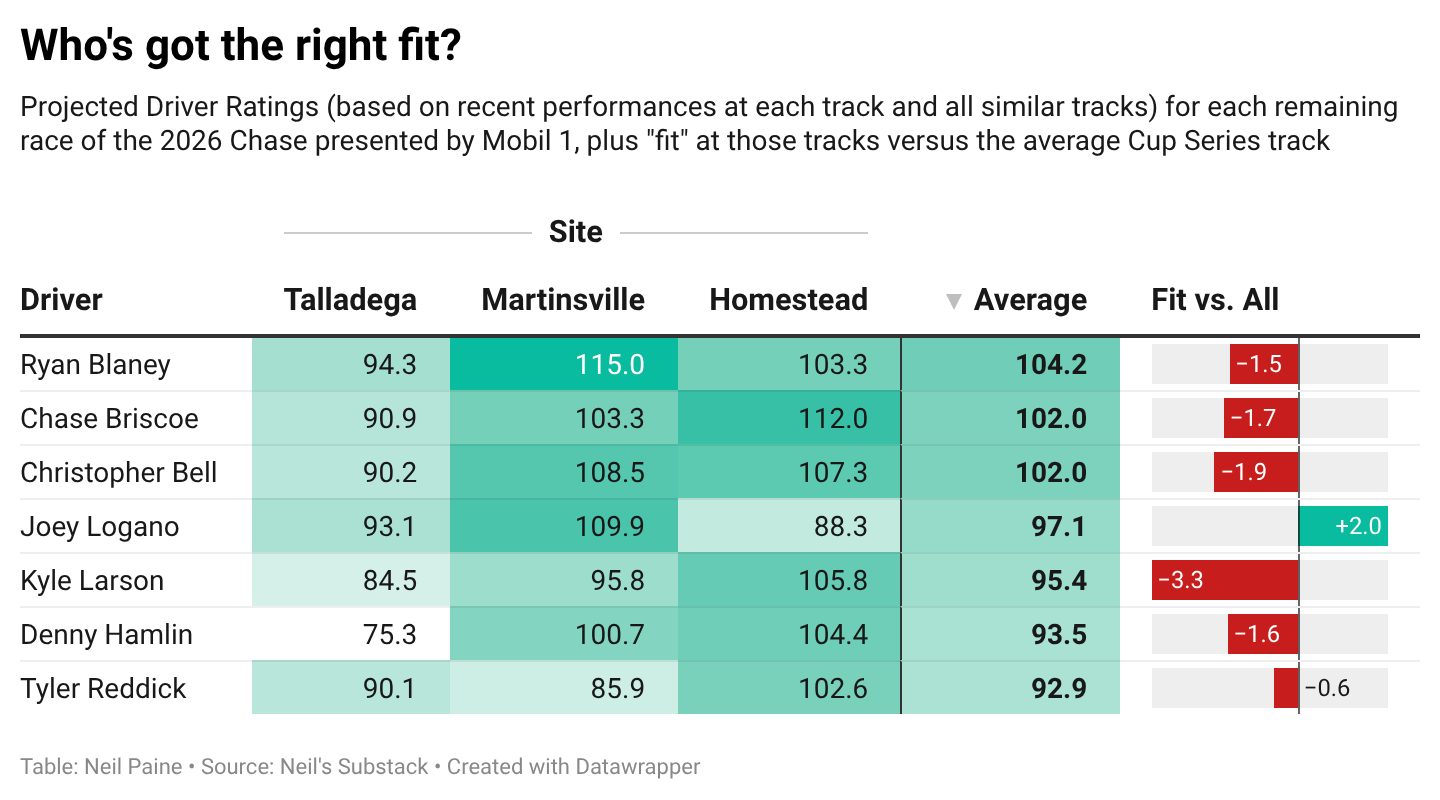
What does this all mean for Talladega this weekend? It just makes NASCAR‘s most feared track the highest-pressure race left on the schedule, too.
In the model, Sunday‘s YellaWood 500 carries the highest championship leverage of any remaining race — meaning it has the greatest potential to swing each contender‘s odds from their current state, for good or for bad. If any of them win at Talladega, they may just find themselves becoming a strong favorite for the title (especially if it‘s Bell, Larson or perhaps even Briscoe) … and if any of them have a disastrous day on par with Larson‘s at Phoenix, or worse — a distinct possibility in the chaos of the draft, with the Big One lurking around every turn — they could drive themselves directly out of the championship picture.
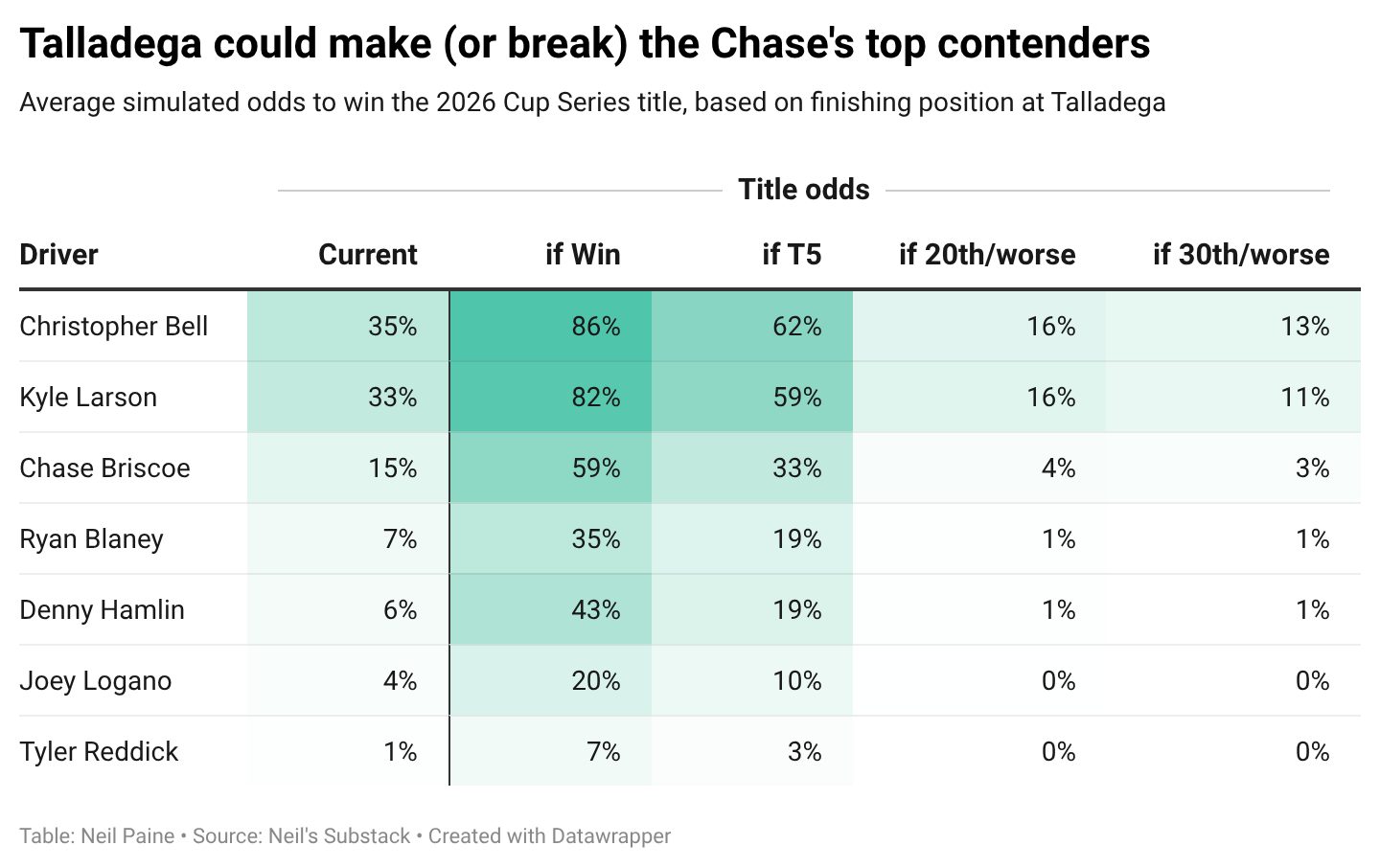
We‘ve already seen how much can change in just the span of a single race: One week ago, Larson seemed to have one hand on the championship trophy. Now he‘s in a serious battle with little margin for error and a bunch of challengers coming for the crown. And with Talladega up next, the biggest moves in this title fight may still be to come.