
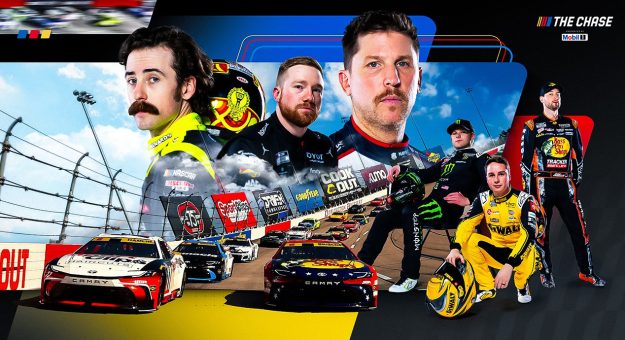
Track: Darlington Raceway
Location: Darlington, South Carolina
Track length: 1.366 miles
When: 5 p.m. ET
Where to tune in: USA Network, HBO Max, MRN Radio, SiriusXM NASCAR Radio
Race purse: $11,849,963
Race distance: 367 laps | 501.32 miles
Stages: 115 | 230 | 367
Sunday’s starting lineup | Pit stall assignments
The path for a new-look Chase — and a title in Homestead — starts now
The blueprint for winning a 10-race Cup Series championship is readily available.
But hardly any of the 16 contenders in the 2026 Chase presented by Mobil 1 for NASCAR‘s premier title have been interested in studying it.
An informal survey at this week‘s Media Day revealed a significant lack of curiosity about how The Chase worked during its first run from 2004-13 before being supplanted by the elimination playoffs.
RELATED: Cup Series standings | Darlington weekend schedule
“I have not looked at it,” Austin Cindric admitted. “Feel free to educate me.”
Well, it was an era of five consecutive championships by Jimmie Johnson, a miracle charge by Tony Stewart in 2011 and an annual coronation at Homestead-Miami Speedway (which returns to the season finale slot this year).
It was also a time before stage points were awarded. Before wins carried a heftier margin over second place. Before the Next Gen radically altered how cars were built and prepared.
“It’s just so different now,” Chase Briscoe said. “Maybe there’s something to learn from the consistency standpoint, but it’s so different.”
Said Cindric: “It’s a completely different world as far as how the sport is run, how the teams are run and how the cars are built. So I guess those days are gone enough for me not to really factor them into how we prepare.”
Having made The Chase for eight seasons as a crew chief before moving into the role of TV analyst, Steve Letarte says there are few “apples to apples” comparisons to the original Chase — except one.
“It is still a 70-day pressure cooker,” he said. “It is 10 weeks of everything you have. There are no races off, no laps off, no days off. The champion is going to have to go through the same 70-day pressure cooker.”
MORE: At-track photos | NASCAR video highlights
Ryan Blaney is the only championship-eligible driver who said he had reviewed The Chase seasons of 2004-13.
“What I appreciate with the guys in those Chase years who could put together 10 really good weeks was their demeanor,” he said. “Their mindsets were obviously incredibly focused and on the end goal. So I like looking at the guys who won it in that format and just seeing their dedication and their motivation. The mentality to just dig in for 10 weeks. I think you can learn from some of that mentally as opposed to on-track performance that‘s not as relatable because it‘s always changing.”
Among this year‘s field, only two contenders have experience with the resurrected format. Top seed Denny Hamlin made The Chase from 2006-12 (and entered the season finale with a shot to win in 2006 and ’10). Joey Logano made The Chase in 2013 and has an overriding memory.
“It‘s 10 weeks of hell,” Logano said. “I heard Jimmie Johnson say that one time and it‘s pretty true. It‘s a grueling 10 weeks, but it‘s a pretty cool trophy at the end of it.”
With the 10-race title run set to unfold starting with Sunday‘s Cook Out Southern 500 at Darlington Raceway (5 p.m. ET, USA Network, HBO Max, MRN Radio, SiriusXM NASCAR Radio), here are some lingering questions (and past trends) to ponder about how the 2026 Chase will unfold based off the 10 seasons in its original iteration:
Does Chase knowledge equal power?
Though Logano and Hamlin are the only drivers with prior Chase experience, there‘s a deep pool of executive leadership that has a strong track record and a wealth of institutional knowledge about how to game-plan a 10-race championship.
Team Penske president Michael Nelson and competition director Travis Geisler played instrumental roles with the organization during Brad Keselowski‘s 2012 championship.
Chad Knaus, who won six championships in 10 years of the original Chase as Johnson‘s crew chief, is Hendrick Motorsports‘ vice president of competition.
“When I look through the garage and see Chad, who dominated The Chase format, still being at Hendrick Motorsports,” Letarte said. “Maybe there was something in his secret recipe that he could kind of try to divvy out to his teams.”
Hendrick‘s trio of Chase drivers said they‘ve seen no formal direction from Knaus, but there‘s a sense that his experience will be a major asset.
“There’s some background there for sure,” said William Byron, who scored his first Cup win with Knaus as crew chief six years ago. “I think that’s probably spread within the organization more so than in just conversations. You hope that there’s some energy from that. Just being Hendrick Motorsports in general, we’ve had a good history of being able to execute at the right time.”
Is Hendrick lying in wait?
Indeed, the hallmark of Johnson‘s title runs was his ability to flip the switch for a late-season surge. In the first two years of The Chase, the No. 48 Chevrolet established points leads during the regular season before fading into the fall. Team owner Rick Hendrick has said he encouraged Johnson and Knaus to look at The Chase as a “parallel program” to roll out cars that delivered a stronger finishing kick.
During his run of five consecutive titles, Johnson never led the points after 26 races but won 13 of 50 Chase races.
“They were able to harness this mentality of we’re the best group here, and we’re going to go show everybody,” Blaney said. “We’re not going to make mistakes. We’re going to dominate pretty much everybody. I just think it was a culmination of just a really talented team and people, and they were able to do all the things right. I bet Chad had some secret parts sitting on the shelf, but at the end of the day, they still had to perform and execute, and they were able to rise to the occasion.”
With only two wins this season, Hendrick will need a similar performance to claim a 16th Cup championship. Defending champion Kyle Larson, who is mired in a 50-race winless streak, said the team has belief that a Johnson-type run could develop despite different circumstances.
“I think you had more tools in your toolbox back then, too, where I think now all the teams are handcuffed in a way compared to that era of racing,” he said. “But when you‘re racing for Hendrick Motorsports, you know at any point, we can turn it around. You just never know when that day might come. It could come next week. It could come tomorrow. You just have to be ready for it.”
Chase Elliott, who has both of Hendrick‘s victories, said that “no one knows what our team’s doing or what goes on behind the scenes. Obviously, the year hasn’t gone like we want it to go from a company standpoint, but no one’s discouraged by that. From a mentality standpoint, from a prep standpoint, just all the little things that are in our control, we’re going to make sure that we’re putting our best foot forward. We just really don’t have a lot to lose right now with the way we’ve been running over the last few months.”
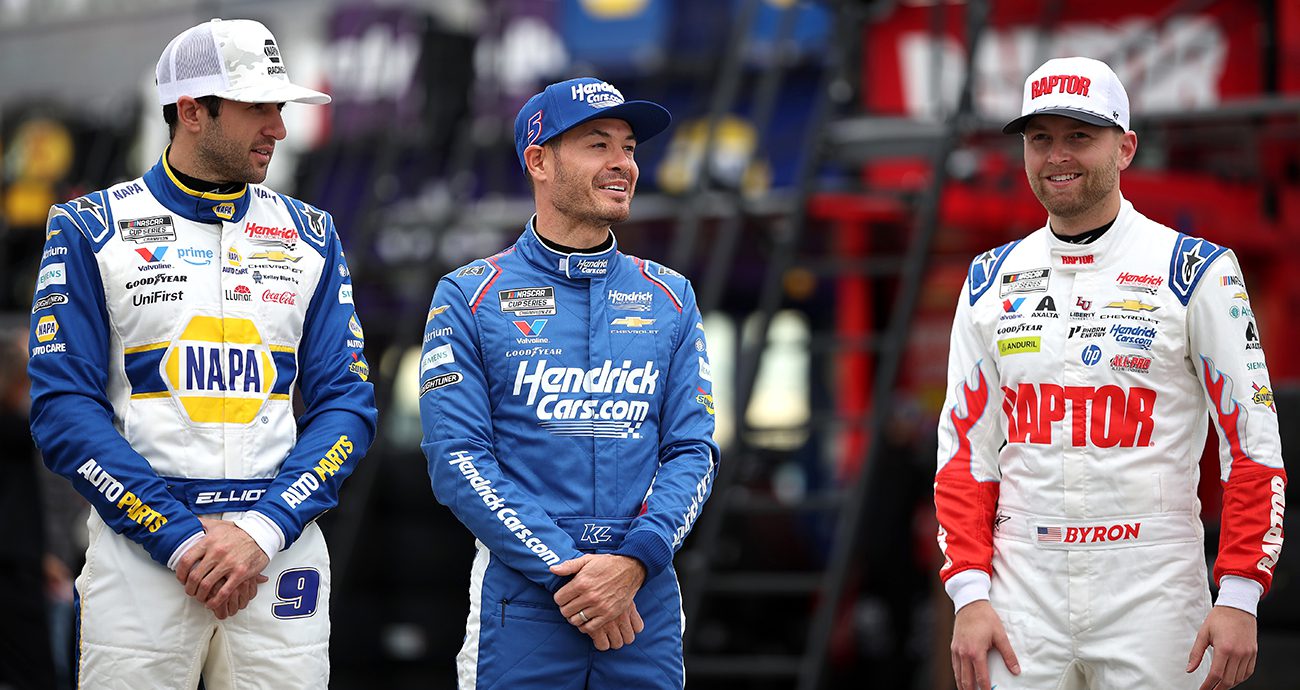
Will Darlington set a tone?
When Chicagoland Speedway started The Chase from 2011-13, it was the first of five 1.5-mile tracks. The top of the speed chart for the opening practice session invariably was packed with contenders heavily focused on the dominant track in the title run.
This year‘s Southern 500 opener at Darlington Raceway might be more of an outlier than New Hampshire Motor Speedway‘s 1-mile oval was from 2004-10. The next two races of the 2026 Chase at World Wide Technology Raceway and Bristol Motor Speedway also could have less bearing as title barometers
But the ensuing three-race stretch at Kansas Speedway, Las Vegas Motor Speedway and Charlotte Motor Speedway will be a critical test of three 1.5-mile tracks that will also offer a preview of the championship finale at Homestead.
“I don’t think you can take a whole lot from Darlington,” Briscoe said of a 1.366-mile track that will feature a lower downforce, higher horsepower package. “The points are obviously going to carry over, but if somebody has a bad run at Darlington, obviously it sets them back points-wise, but I don’t think that’s going to dictate how they run the rest of The Chase. I don’t think there’s a whole lot you can take away from really the first three weeks. After that, I think you’re going to really have an idea of who’s going to be there.”
A mulligan or more?
Unlike the threat of first-round elimination in the playoffs, Chase champions have gotten away with weak starts.
The best example was the first title for Johnson, who finished 39th at New Hampshire and didn‘t earn his first top 10 until the fifth race of the 2006 Chase. He won the title with an average finish of 10.8 — the only Chase champion with an average worse than 9.0.
The conventional wisdom was that you could have one poor result in The Chase, but it also depends on how the competition fares. Blaney believes this year‘s champ will need to average a finish between sixth and seventh (the 10 Chase champions from 2004-13 had a cumulative average finish just under 7.0).
“I think it is really important to get off to a good start, if you can, but for sure, it’s not the end of the world if you don’t,” Elliott said. “But the more bad weeks you have, you‘re going to have to be pretty darn good to make up for it. If you have a slip-up (at Darlington), you better have the ability to win and do it often to climb out of a bad race or two.”
Three champions opened the original Chase with a victory — Kurt Busch (who won the inaugural Chase race at New Hampshire in 2004), Tony Stewart (2011) and Brad Keselowski (2012).
Talladega terror?
Christopher Bell is mindful that the first seven races will likely determine if he races for the title.
“I’ve been kind of making a small joke that if I am going to be the champion, then I better have a points gap on the field going into Talladega,” Bell said. “The first seven are all really good tracks for me. So, I think my best hope is that I have a points gap going into the final three.”
Talladega was the most feared track in the original Chase, and it never fell so late in the schedule — the eighth of the final 10 races in 2026. From 2004-13, it fell between the third and sixth races eight times and was the seventh race twice.
With only Martinsville and Homestead remaining after 500 miles on the 2.66-mile oval this season, it looms as the most decisive track in The Chase for both destroying or salvaging title bids.
“I look at Talladega as a momentum ender, but also as a great opportunity to capitalize on others‘ mistakes and pitfalls,” said Bubba Wallace, who earned his first Cup victory there in 2021.
Briscoe said Talladega will be the race “where everything’s going to change. There’s just so many points that can be lost there. You really don’t have a mulligan in The Chase, but if you’re going to use one, it’s going to have to be at Talladega, and that’s just where it makes it the other nine weeks so hard because if you have a bad race at one of those other nine, you have to go to Talladega and have a good solid day, and that’s where the points are really going to get flipped upside down.”
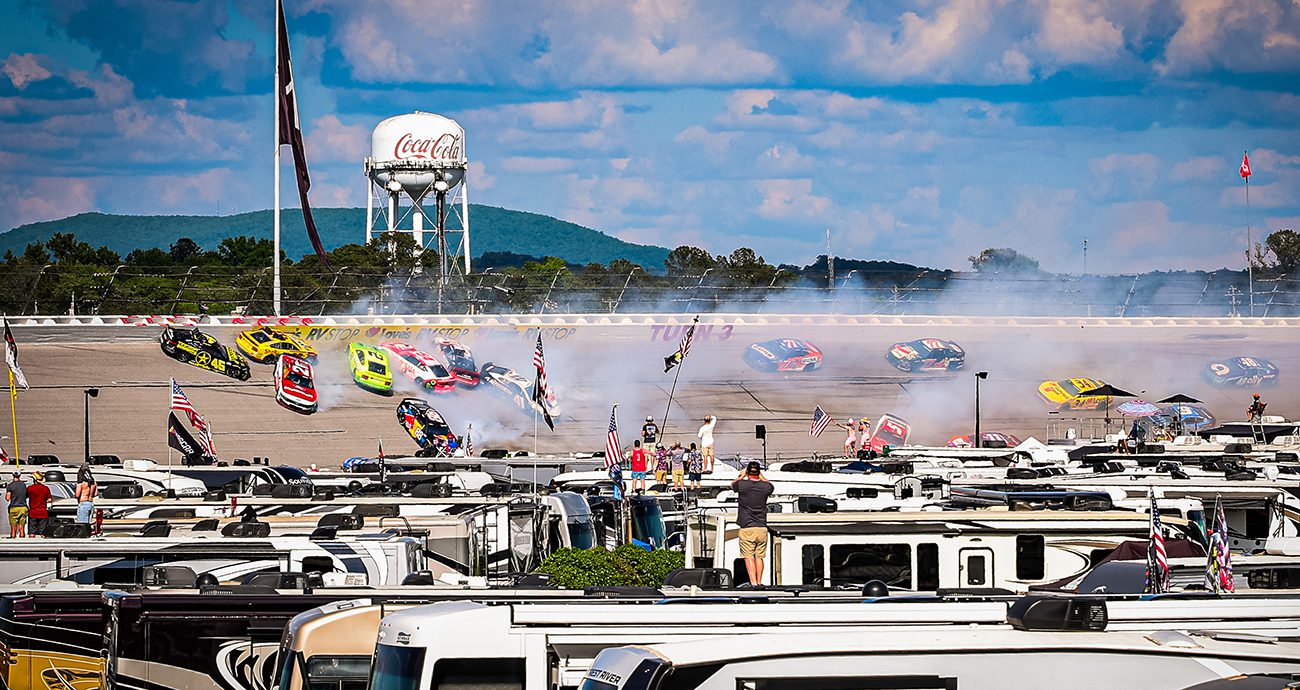
Top Six or bust?
According to Racing Insights, The Chase champion was projected to come from the top six in regular-season points in 85 percent of 25,000 computer simulations. The modeling is based on historical performances (which mostly would have come under the previous playoff system of 2014-25).
Can a driver outside the top six pull an upset? There‘s some hope to be found in two examples of massive points swings this season. Tyler Reddick lost a 129-point lead in six races, and Ryan Preece made up a 50-point deficit in two races to make The Chase.
Bell, who enters The Chase in sixth place, declared on Media Day that the champion will come from the top six, but opinions were split elsewhere.
“Anything is possible, but when you look at who has had the speed, a lot of the cars and teams that have had the speed at the tracks that make up the majority of The Chase are kind of in that top six,” Reddick said. “It does get harder the further back you are. You are starting in a hole.”
Cindric, who will start in 15th, said as long as it‘s mathematically possible for any of the other 16 drivers to win the championship, “that’s all I need to know. You’re telling me there’s a chance. That’s really all you can look at.”
Preece, ranked last but brimming with confidence after his victory at Daytona clinched a Chase spot, isn‘t a believer in the top-six theory.
“Not at all because I think those guys are going to race the hell out of each other and if they have a couple of bad races, there‘s no win and you‘re into the next round,” Preece said. “It‘s going to be tough to make up those points.
“Just because you‘re 16th in points doesn‘t mean you didn‘t execute a great season. We didn‘t luck into that win (at Daytona). We ran up front. We executed. We did everything we needed to do as a Cup-winning caliber team. If we show that for the next 10 weeks, we can do it. It‘s not easy, but we can do it.”
Speed reads
Race-day essentials:
• Darlington hub: Key information, pit stalls, additional results | Read more
• Sunday Setup: Crew chiefs get set for “Too Tough to Tame” test | Read more
• Paint Scheme Preview: This week’s Chase-opening designs for Darlington | View gallery
• Neil Paine: Can Denny Hamlin be a force in new Chase format? | Read more
• NASCAR Classics: Browse the video archives for full-race replays from Darlington | Watch now
• Power Rankings: Hamlin heads the top 16 as postseason begins | This week’s ranks