
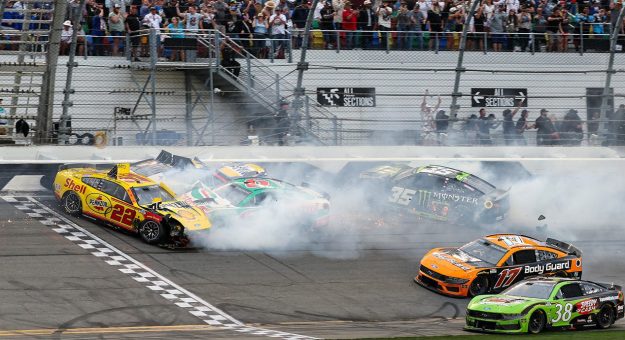
If it seems like NASCAR has been short on its trademark late-race chaos recently, you‘re not imagining things.
On Sunday at New Hampshire, Ryan Blaney drove a masterclass in overcoming a mid-race problem on pit road (what else is new?) to hold off rivals on varying tire strategies. Crew chief Jonathan Hassler made the inspired call for two tires when the No. 12 came to pit road with around 75 laps to go. But Blaney had the chance to flex his car‘s long-run quality because the final run went, well, long. The last 63 laps of the race were run under green-flag conditions, and Blaney led every single one of them.
As it turns out, that‘s been the new abnormal this Cup Series summer. But be warned: It‘s also about to change, with Chase spots — and everything else — on the line in the regular-season finale Saturday at Daytona (7:30 p.m. ET, NBC, HBO Max, MRN Radio, SiriusXM NASCAR Radio).
Those 63 closing green-flag laps at Loudon represented 20.9% of the 301-lap race, and somehow that was actually a short closing stint by recent standards. The week before at Richmond, the final 108 laps — or 27.0% of the race — were conducted under green, with winner Joey Logano leading the last 25 laps. A week before that, at Iowa, the final 132 laps (37.7%) ran under green as well, with winner Ty Gibbs leading the last 20.
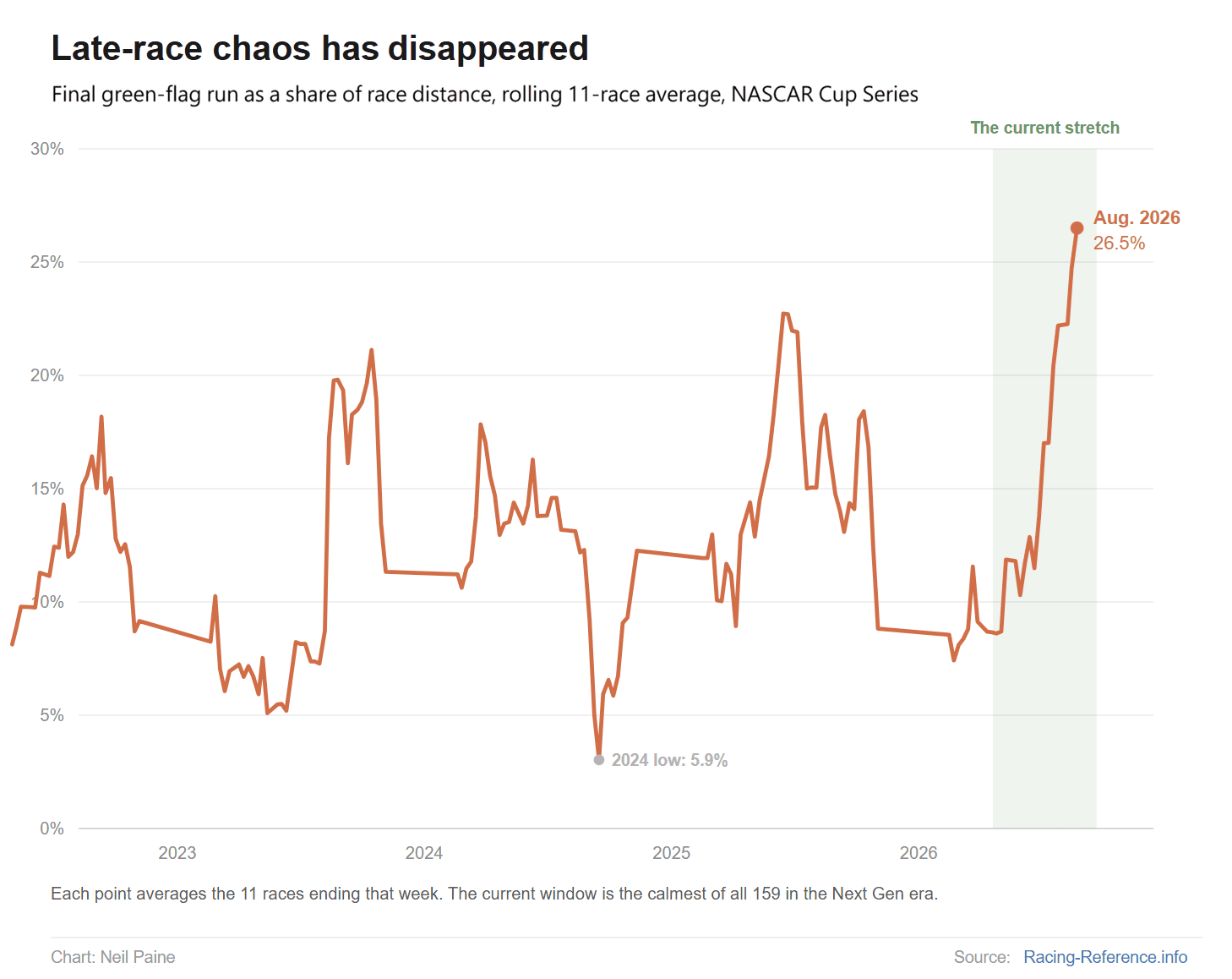
All told, only one of the past 11 races — EchoPark in Round 20 — had a final green-flag stint shorter than 16% of the total race distance, and the average final-stint share under green in that span was 26.5% of the full race:
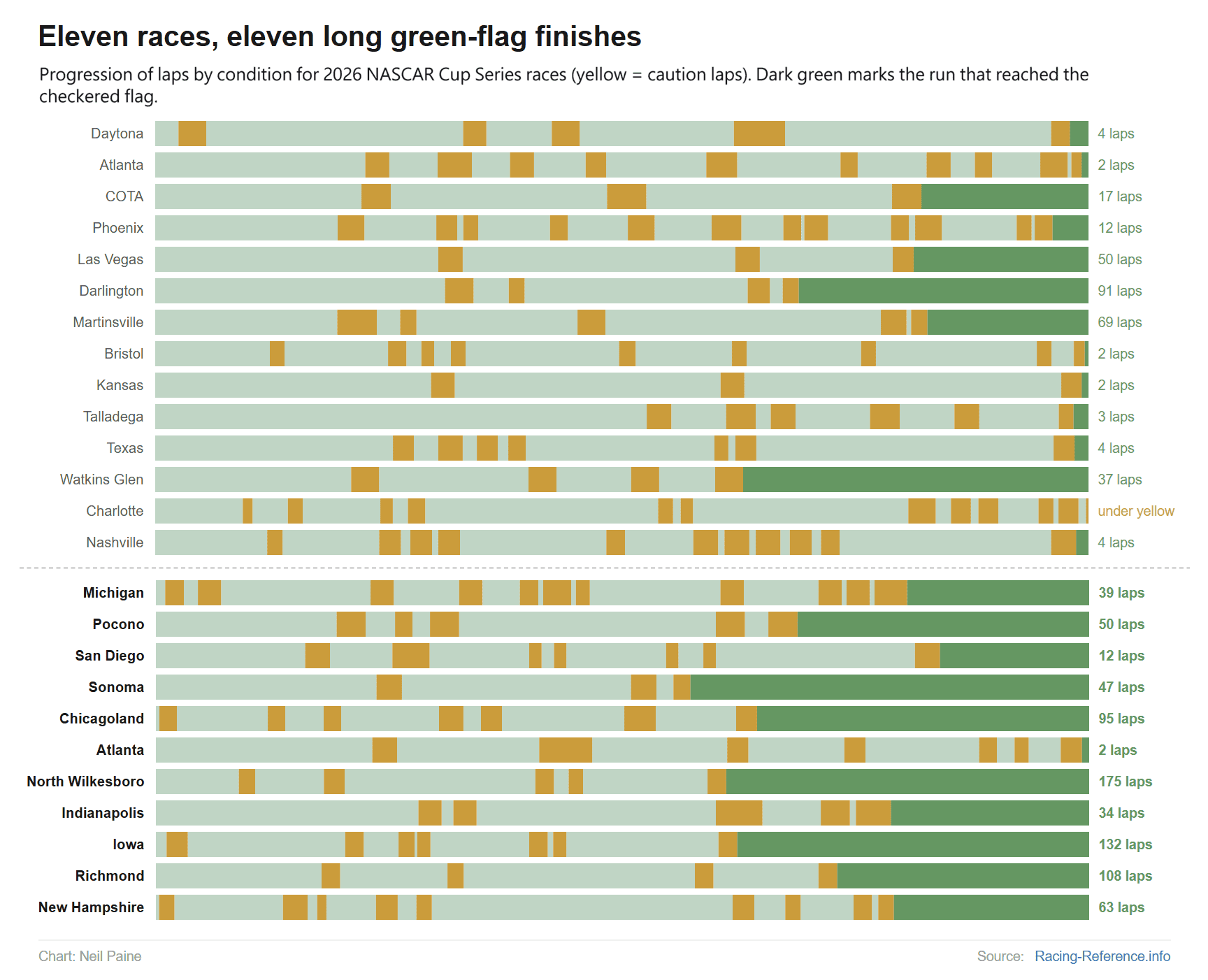 Needless to say, that‘s not what we typically see over such an extended period. In fact, during the Next Gen era (since 2022), this is the highest average share for closing green-flag stint lengths in any 11-race period, beating out late March to mid-June of last year (22.7%):
WATCH: NASCAR video highlights
As you might expect, this trend has favored the best drivers — or at least the most dominant teams of the day.
Thus far in the Next Gen era, when a race has finished under yellow and/or the final green-flag stint has accounted for less than 2% of its total length (a sample that includes many overtime finishes), the eventual winner has led the most laps just 21.2% of the time and averaged a laps-led share of just 15.4%. But when the final green-flag stint has accounted for more than 2% of the race‘s total length, the winner has led the most laps 48.9% of the time, and the winner‘s average share of total laps led has jumped to 32.2%.
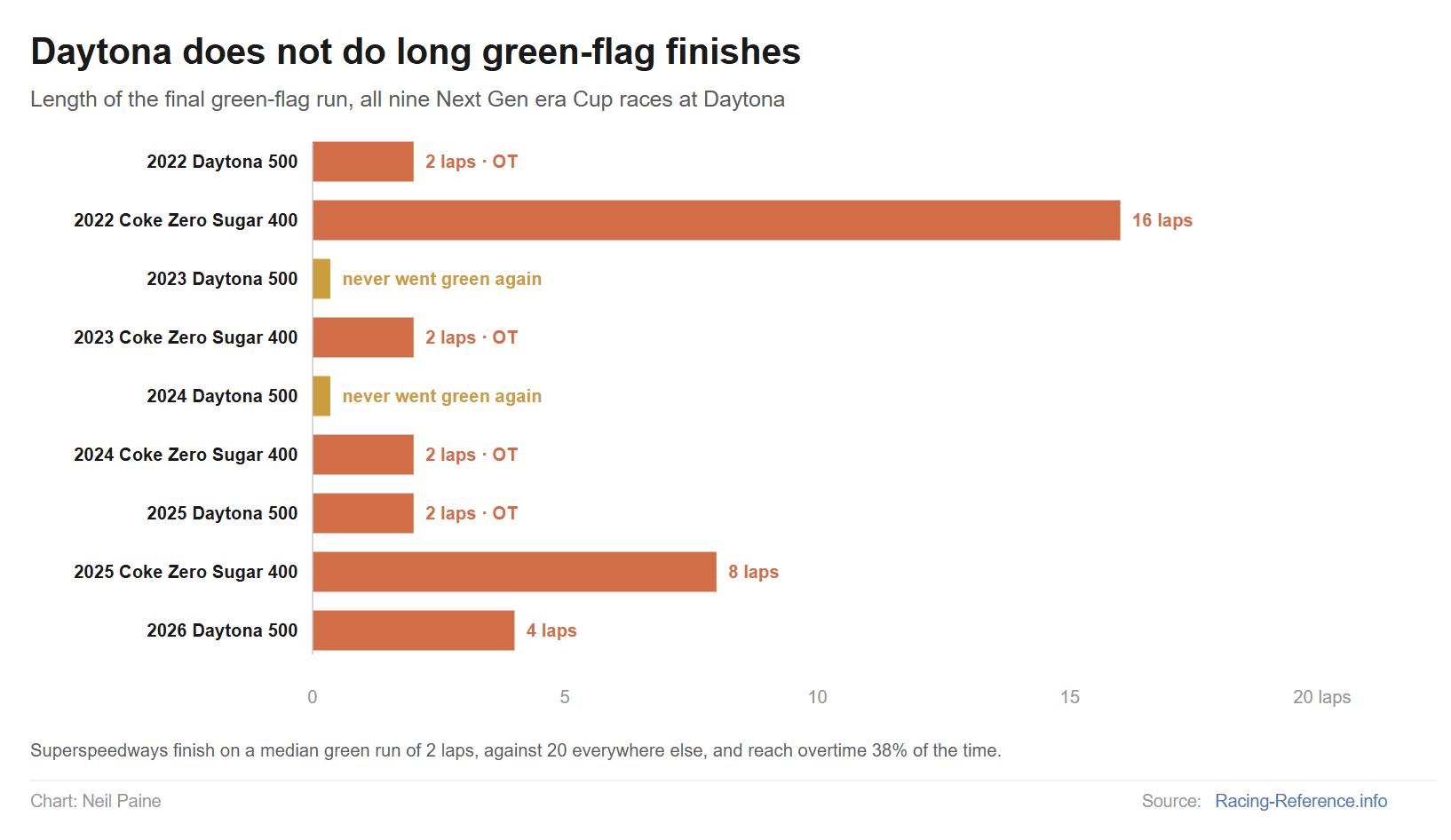
That‘s been good news for teams and drivers with great equipment, speed and strategy — and it has fundamentally reshaped The Chase standings compared with where things stood before the summer calm. However, the Daytona storm is here to shatter that sense of stability. If we look at all Next Gen-era Cup races at Daytona, the average final-stint share is just 2.4% of the race, including two that finished under yellow and only two that went longer than 2% of the total race laps under green at the end — the 2022 Coke Zero Sugar 400 (10%; won by Austin Dillon) and the 2025 Coke Zero Sugar 400 (5%; won by Blaney):
 And what a time for things to get scrambled, because a lot will be at stake Saturday. (It‘s almost like the schedule-makers knew what they were doing!)
For one thing, five drivers remain eligible for three unclaimed spots in The Chase. The central cutline battle, though, is between Shane van Gisbergen and Ryan Preece. SVG has a 31-point cushion in the standings, so he is a strong favorite to grab the last spot — particularly considering he has a much higher average Driver Rating on drafting tracks this season (80.9) than Preece does (66.3). But given Daytona‘s potential for chaos, even a 31-point lead is not completely safe.
Beyond that, the fight will be all about seeding. Denny Hamlin already clinched the most important seed, No. 1 overall, before even rolling out on the track this weekend, which is a relief for the No. 11 team considering his surprisingly poor form at the “World Center of Racing” in the Next Gen era: In nine starts there since 2022, Hamlin has finished 24th or worse in seven of them.
Below Denny, though, the closest gaps in the standings belong to No. 7 Kyle Larson over No. 8 Chase Elliott (one point), No. 10 Chris Buescher over No. 11 Carson Hocevar (four points), No. 9 Joey Logano over Buescher (six points) and No. 12 William Byron over No. 13 Daniel Suárez (six points). Given what we know about how final regular-season seedings lead to eventual Chase rankings, the most important of those battles in terms of the championship might be over Larson‘s current spot in the pecking order.
Otherwise, the closest fights among the top six drivers in the current standings are No. 5 Christopher Bell‘s 11-point edge over No. 6 Chase Briscoe, and No. 3 Ty Gibbs‘ 20-point gap to No. 4 Tyler Reddick. Those battles may prove every bit as important as the fight to be in the top seven — likely the very edge of where the eventual champion might emerge from — or the SVG-Preece scrap to make The Chase at all.
But that‘s the catch with taking all these carefully accumulated advantages to Daytona for the regular-season finale: They can disappear in an instant.
For most of the summer, NASCAR has rewarded the drivers who were fastest and smartest over long, uninterrupted closing runs under green-flag conditions. But now, with The Chase field and its final seeding order ready to be set at last, the end of the regular season may come down to something we‘ve barely seen in the past three months or so — one late restart and a couple of laps of pure chaos, with everything on the line.