
NASCAR on Wednesday revealed rules updates to the Cup Series’ superspeedway package for Daytona International Speedway for the Aug. 29 regular-season finale.
The rear spoiler will be shortened from 7 inches to 4 inches, the same height as intermediate tracks, in an effort to reduce drag, along with a slight reduction in horsepower from 510 to 465 to adjust for the reduced downforce. NASCAR officials anticipate single-car runs to be approximately 3 mph faster than the current package, but cars in a pack are expected to run about the same speeds.
MORE: Cup standings | Cup schedule
The changes come in advance of the Coke Zero Sugar 400 at Daytona, with hopes of less drag providing more opportunities for drivers to better move through the field by passing rather than relying upon track position through various fuel-saving strategies.
Three-time Daytona 500 champion Denny Hamlin and NASCAR Event Management president John Probst both served on a larger working group that determined possible adjustments. While these changes are set for the upcoming race at Daytona, any determination for future superspeedway races will be confirmed at a later date.
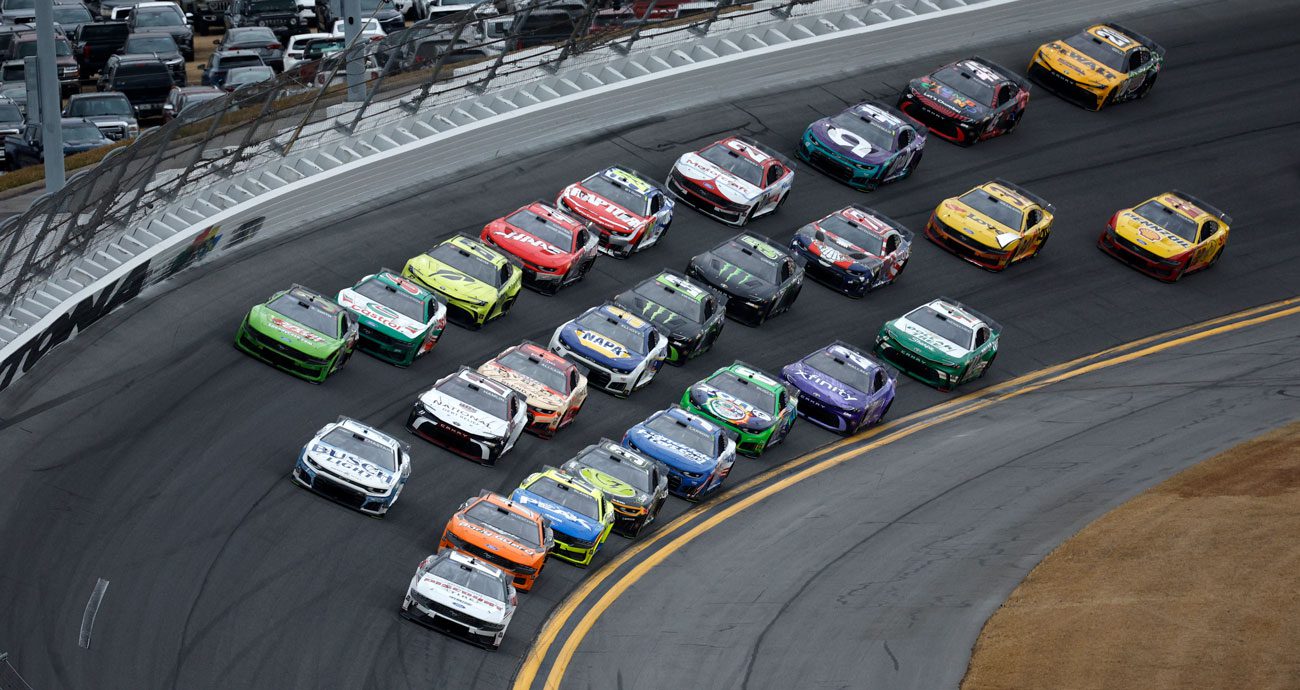
Hamlin, driver of the No. 11 Joe Gibbs Racing Toyota and co-owner of 23XI Racing, noted the high quality of racing in Sunday night’s event at EchoPark Speedway near Atlanta in an appearance with former crew chief Steve Letarte and Probst on “Inside the Race.” He pointed to EchoPark’s 1.5-mile track length as a benefit of the 7-inch spoiler, but the 2.5-mile Daytona and 2.66-mile Talladega Superspeedway layouts offer fewer passing opportunities with the higher-drag 7-inch spoiler.
“What we’re essentially trying to recreate is Atlanta at Daytona and Talladega,” Hamlin said. “It happens organically at Atlanta, the space between the cars, because the cars themselves are grip-limited, and the fuel-mileage (racing) really doesn’t happen because you have to be on offense constantly. If you watch the pack, there is no saving. Guys are dicing it up the entire race. So this is what we’re aspiring to get to at some point. And it’s going to take chunks here and there. This is our first bite of the apple at this, so what I believe is that from the numbers that I’ve seen, it’s going to be roughly a 33% gain in the right direction.”
Letarte explained that the ultimate goal of switching to a shorter spoiler is to give drivers stuck mid-pack an outlet to create their own moves and build runs on the cars in front of them to overtake, rather than riding stuck in line.
MORE: Watch NASCAR video highlights
“When I watch superspeedway racing currently, it seems like the leader is basically at terminal velocity,” Letarte told NASCAR.com. “It’s very easy to get a run on the leader and very hard to do anything with it. You pull out of line, you hit this wall of air, and for that reason, they’re just kind of stuck two-wide around the bottom. When superspeedway racing is most entertaining for me, it takes more work to generate an advantage or a run. But when you do generate that run, you are paid off in a dividend of overtaking. And really, I think it’s as simple as that.
“I think what I see currently is our biggest track-position races of the year are the superspeedways. That’s never been their signature. And we can talk about fuel and strategy, but the garage is going to try to win the race. So if the strategy demands track position, they’re going to do everything to get it. If the aero changes can allow teams to overtake to have faster cars and slower cars, I think it could open up the field a little bit and have just varying-speed cars because right now they all look like they run the same speed.”
The change comes in an attempt to improve superspeedway racing at NASCAR’s top level after adjustments made to do the same at other track types.
“As you’ve seen with NASCAR over the last few years, since the Next Gen, they’re not afraid to just keep fine-tuning it and getting it good at all these race tracks,” Hamlin said. “We’ve seen them make some horsepower adjustments on the short tracks in order to make those and road courses race better. Intermediates obviously speak for themselves; they don’t need a whole lot with how well the Next Gen races there. But then the next step is OK, let’s work on our superspeedway package from here on out. So I think that this was a great collaborative effort to get the racing product as good as it can be for the fans.”
Making this alteration with two superspeedway races remaining on the Cup Series calendar also feels like the right time for an adjustment, Letarte said.
“The unfortunate or fortunate part is our season kicks off with the biggest race of the year, the Daytona 500,” Letarte said. “And I believe that our car cycles, our rules cycles, are not the same. Everything doesn’t happen in the winter for another upcoming season. So I actually think this is the appropriate cycle for speedway racing. You have to remember, there’s no more win and you’re in. The Chase is about accumulating points. You’ve had 25 other races to score enough points to go down there with the unknown of what this race is going to be. We have a speedway race in The Chase that I think will be tough to then try something brand new. So I actually believe that this is the correct cycle. I think Daytona in August becomes a great test bed for then the ‘Great American Race’ in February.”
For NASCAR to act quickly in correcting a perceived issue is not a coincidence. A separate change was made to stage lengths at Talladega in the spring in an effort to reduce the incentive to save fuel. Probst points to leadership from the sport’s front office as a key driving force toward bettering the racing product.
“We want to react quickly,” Probst said. “You know, Steve O’Donnell, our new CEO, is on us all the time to get the feedback and react on the feedback as quick as we can. And I think that working with Denny and the working group there, we made changes that we felt had the highest potential to make a big change, but with the lowest risk as well. Like, we didn’t pull every lever that we could because some of those would frankly require us to get 15 cars down to Daytona and try some more radical stuff. We’re not against doing that, but that certainly would affect the timing in which you unroll that level of a change for.
“So we got that group together. I feel like everybody in there brought their opinion and provided really good feedback. And I think that where we landed is the biggest change we feel like we can make without doing a full-blown test.”
What comes next, officials anticipate, is maneuverability that allows drivers to reclaim their star power by earning their way back through the field on the track rather than through pit strategy.
“I can tell you from the driver’s seat what happens for us is that we spend the entire race fuel-mileage saving all for that last pit stop,” Hamlin said. “We basically know you have to be in the top four inside that last fuel window, unless there’s a big wreck, to have a shot at winning. I mean, if you come out 10th, you are log-jammed; you’re not going anywhere. And with the cars having as much drag as they have on them, then you can’t pull out of line to be offensive to get your track position back.
“So we’re trying to make it to where it allows the drivers to pull out of line when they get a run, and then hopefully create a little bit of space between them to allow them to get back in line, so it’s not going to make them so apprehensive to go make that bold move with 30 to go.”
The Coke Zero Sugar 400 is set for Saturday, Aug. 29, at Daytona International Speedway, with coverage at 7:30 p.m. ET on NBC, HBO Max, MRN Radio and SiriusXM NASCAR Radio.