
Christopher Bell‘s winless 2026 season is not at all the case of a driver searching for speed.
The No. 20 Joe Gibbs Racing driver has simply been too good for too long for this year to be framed as a competitor who simply cannot close, either — Bell‘s 13 career Cup Series wins over his first six seasons, four of which came last year alone, settle that argument before it starts. The Oklahoma native has repeatedly demonstrated that he knows what to do with a race-winning car, whether on dirt, asphalt, concrete, concrete covered in dirt, you name it.
And yet, 20 races into 2026, his season is becoming defined by everything but that final step — and it‘s the one that matters most.
Five runner-up finishes. Eight top fives. A pole. Three stage wins. A fifth-best-in-the-series 422 laps led.
Zero wins.
That combination has placed Bell in increasingly rare company. His five runner-up finishes are the most by a winless driver in a season since friendly rival Kyle Larson had six in 2018. Through 20 races, only Terry Labonte in 1982 had more second-place finishes without a win; Harry Gant also had five at the same point in 1981.
The easiest read would be that Bell has repeatedly failed to convert opportunities. Dig deeper, and the accurate analysis reveals significantly more confounding context.
RELATED: See Bell in latest Power Rankings
At Phoenix Raceway this spring, Bell led 176 laps, won the second stage and finished second to Ryan Blaney. Dominant, but a near-miss. He then came from 17th to finish second at Charlotte, leading 44 laps before rain helped hand the victory to Daniel Suárez. Bell started fourth and led 29 laps at Nashville before watching teammate Denny Hamlin nearly double his points output despite finishing just one spot higher. At Chicagoland, he followed another JGR teammate, Chase Briscoe, across the line, furiously chasing him down to no avail. Then, at EchoPark Speedway, Bell drove from 32nd to second and finished a frustrating 0.068 seconds behind Blaney, pushing the No. 12 to his second win of the season.
Those are five runner-up finishes, but not quite five copies of the same outcome. Bell sometimes had the dominant car. Sometimes he recovered from deep in the field. Sometimes, another championship-caliber driver was simply better by the end of the race.
Every time, though, the result was frustrating.
That said, the EchoPark run was the latest example of how much of the operation remains sound. NASCAR Insights ranked Bell fourth in defense and ninth in speed during the race, while the No. 20 pit crew ranked first. Bell‘s season-long profile is even stronger: sixth in passing, fifth in speed, fourth on restarts and fourth in pit-crew performance — certainly championship-caliber.
Racing Insights’ deeper pit crew numbers support that ranking, too. Bell‘s team owns the fastest average clean four-tire stop in the series at 9.56 seconds, a 95% clean-stop rate, and ranks second in line-to-line performance, retaining position on 82% of stops. The No. 20 team has not been consistently losing races because it lacks support around the driver on pit road.
It’s almost entirely race-context-driven. Not performance.
There may be no statistic that captures Bell‘s season better than this one — his 422 laps led through 20 races are actually an increase of 268 over the same point last year. Bell had already won three times through 20 races (believe it or not, they actually all came in the first four races) in 2025 despite leading just 154 laps. This season, he has nearly tripled that total without reaching Victory Lane once.
Bell has also led more laps this year than JGR teammates Briscoe and Ty Gibbs combined. Both have won. Bell has not.
That is not remotely an indictment of No 20, but rather a notion worth investigating as to why his missing win remains so dubious.
The near-misses, of course, also extend beyond the five runner-up finishes. Bell was running second in overtime at Atlanta in February when contact from Carson Hocevar left him 21st. He was third before being collected in overtime at Kansas and fourth before running out of fuel with two laps remaining at Pocono. Racing Insights calculated those three results alone as a costly combined swing of 58 points.
Those are just regular-season losses now; not ideal, but survivable. The same pattern would carry much more weight in The Chase, particularly if he continues to be held out of Victory Lane.
Bell is ninth in points and sits 113 above the cutline, so Chase qualification is not the pressing concern. His 127 stage points rank sixth in the series, another indicator that the No. 20 has regularly operated near the front and will likely continue to do so a month and a half from now. The larger question is whether a driver — who certainly was among the preseason chalk picks for the championship — can reasonably be viewed as a title favorite after going an entire regular season without winning, regardless of how encouraging the underlying data may be. Numbers are numbers, after all, but you either have the points or don’t.
MORE: Watch NASCAR video highlights
A winless Bell would still enter The Chase as dangerous, sure. He would also enter mostly as a projection of what could happen, not necessarily what will. Sure, Bell, perhaps more than most, is capable of ripping off consecutive victories, which would perhaps be necessary if he’s stuck in the middle of the Chase field and has title aspirations. But “can happen” and “will happen” are not the same. At all.
That does not make a title impossible; it just makes his case harder to trust.
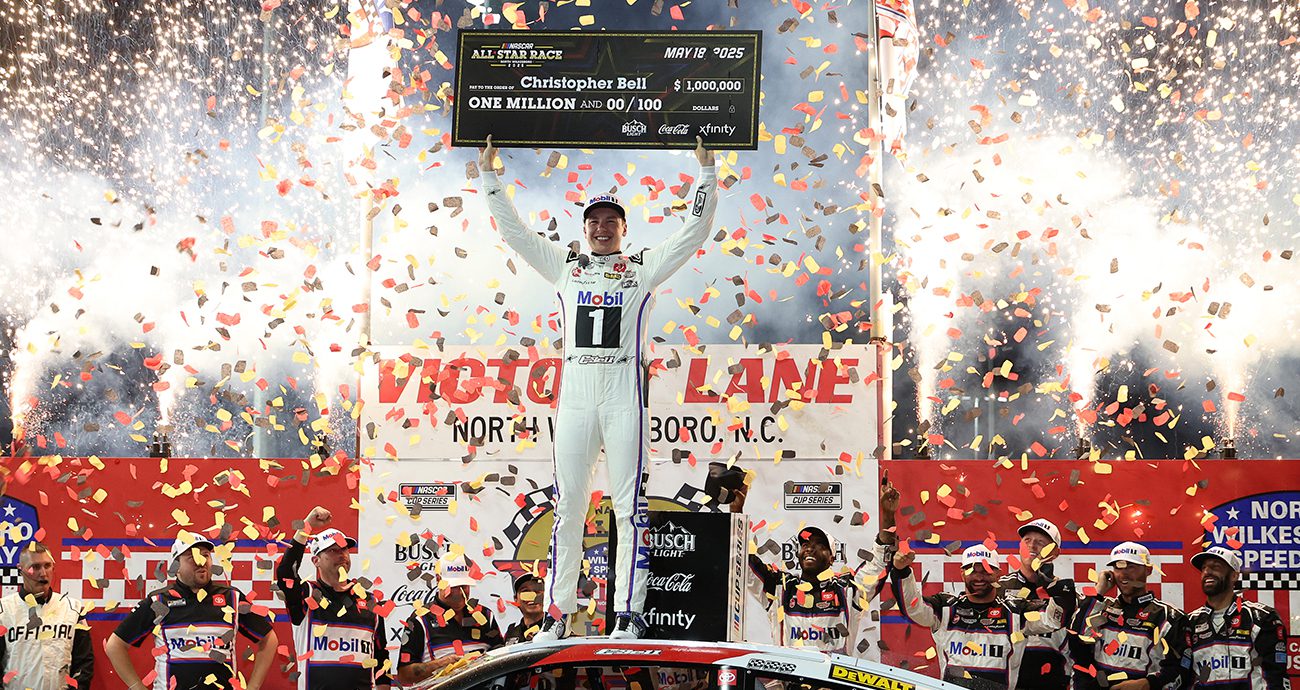
Which leads us here — North Wilkesboro is the logical place for Bell to take everything that was just laid out and turn it completely on its head.
The Cup Series has not held a points race there since 1996 — when a not-yet 2-year-old Bell had probably just mastered walking, let alone holding a steering wheel — so the modern evidence comes from three All-Star events (2023-25) rather than a conventional track history. But Bell‘s sample is still meaningful. He won last year‘s All-Star Race at the track, leading 28 laps, and his broader short-track resume makes the fit more than circumstantial. Bell has two wins, 21 top 10s and an 11.9 average finish in 35 career short-track starts. He has finished in the top 10 in 12 of the last 17, including a Bristol victory last September — his most recent Cup win, 27 races ago.
He also enters this weekend with three consecutive top-five 2026 finishes and back-to-back runner-ups, with the In-Season Challenge adding another layer on top. Bell‘s matchup with Blaney — another of the series’ hottest drivers and Sunday’s EchoPark winner — puts the pairing under the spotlight as the ISC matchup of the week, adding even more pressure for Bell to perform. The duo is dead even at 82-82 in head-to-head better finishes during the Next Gen era, although Blaney owns a 12-8 advantage this season and a narrow 13-12 edge on short tracks since 2022.
Bell beating Blaney would advance him to the championship matchup next weekend at Indianapolis Motor Speedway. Winning North Wilkesboro itself would accomplish that — but would also signify much more.
It would not retroactively ease the pain of every missed victory or erase the days that slipped away for reasons outside his control, but it would provide the one piece of evidence his otherwise formidable season still lacks: proof that all this speed, track position and organizational strength can produce a complete Sunday before the Chase begins. That may be the one remaining box to check over the next six weeks for him and crew chief Adam Stevens.
Bell does not need a win to validate his ability. He needs one to change the way his 2026 season — along with his championship prospects — is shaping up.