
CORONADO, Calif. — Setting up a race car to compete at an active United States military base sounds like an objective straight out of a video game.
For crew chiefs in the NASCAR Cup Series, that became a reality in preparation of Sunday’s inaugural contest at Naval Base Coronado, just across the bay from San Diego.
MORE: Schedule: Naval Base Coronado | Starting lineup
Their notebooks were slim but not empty — not after three years of street racing in downtown Chicago from 2023 through 2025. Stephan Doran, crew chief for pole-winner and street-course-dominator Shane van Gisbergen, said prior experience at the Chicago Street Course gave them a starting point, but Friday’s 50-minute practice revealed the more realistic challenges he and his competitors will face this weekend.
“I just leaned on what seemed like the closest track we had been to, which was Chicago, and kind of started there, but just had Plan A, B, C, D for if something was different — which it was,” Doran told NASCAR.com Saturday. “The tire wear was extreme compared to Chicago. Corner speeds are similar, though. I think shocks and springs are similar to what we had in Chicago, but tire wear was not, so we’ve had to adjust for that through the weekend.”
Goodyear Racing delivered a familiar road-course tire to San Diego, utilizing the same compounds used in all six road and street races in 2025 as well as earlier this year at Circuit of The Americas and Watkins Glen International. But Coronado’s course presents many unique differences — among them, four different surface types between worn asphalt, fresh asphalt, worn concrete and fresh concrete. Following Friday’s practice, NASCAR allotted teams an extra set of tires for Sunday’s race, upping their total to 10 dry-weather sets after feedback from teams.
“It makes it a little easier,” said Doran, who oversees SVG’s No. 97 Trackhouse Racing Chevrolet. “I think everybody was stressed about just having enough tire to get to the end of the race, where I think we have that now. We still don’t have extras, really, at least if the tire wear stays the same for Sunday, which I think it will. I think it’s going to be extreme all day.”
Drivers and crew chiefs alike compared the tire wear to what was seen last fall at the Charlotte Motor Speedway Roval, a combination road course and oval that produced excessive tire wear on its worn asphalt surface.
“The Roval, we kind of had that all day and had to manage it,” Doran said. “It’s just a much longer lap here, so we can go less laps here than we could at the Roval.”
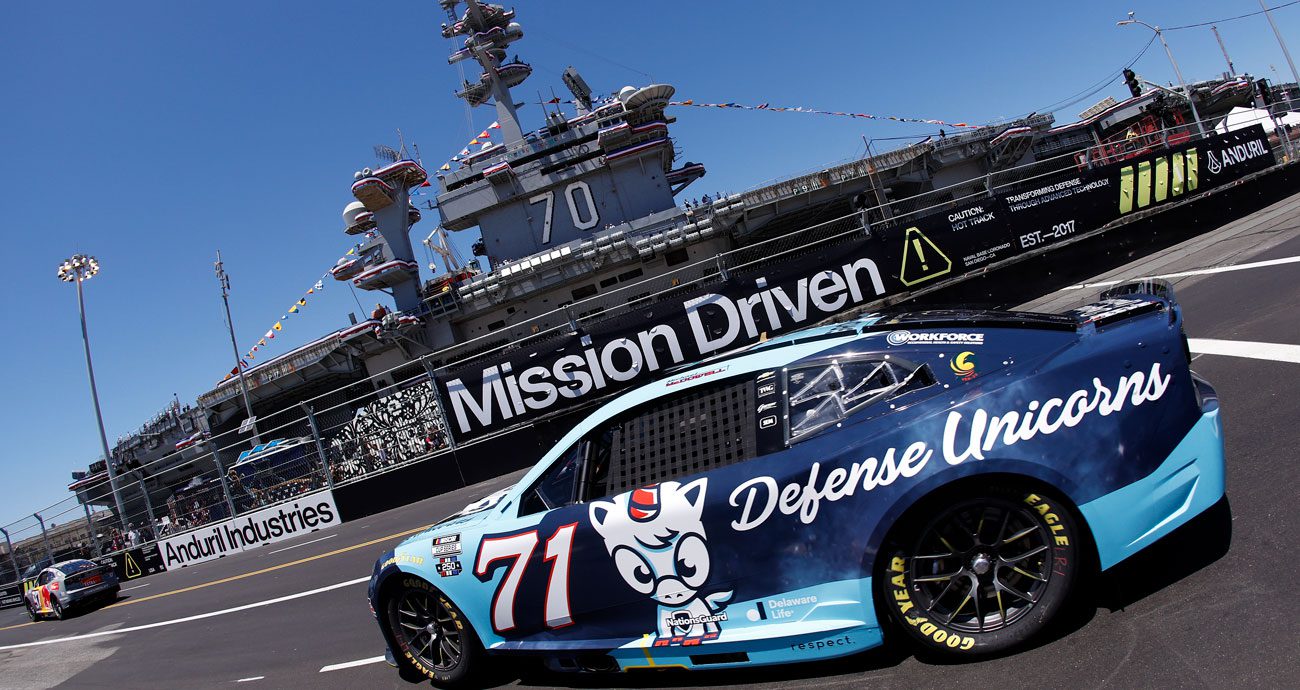
Travis Peterson, crew chief of the No. 71 Spire Motorsports Chevrolet for driver Michael McDowell, acknowledged “tire life” will be the deciding factor in teams’ strategy through Sunday’s 75-lap race. But how exactly long the tires will last remains to be seen. No driver in Friday’s practice completed even 10 consecutive laps before returning for adjustments.
“The reason they gave us that set is because we’re gonna need every single one, so it’s going to certainly be interesting,” Peterson told NASCAR.com. “I don’t know that anybody’s ran a long enough run to have any idea what’s going to happen (Sunday) yet until we get into Stage 1.”
A typical strategy executed on road courses is flipping the stages: pitting at least two laps before the stage end for better track position when the following stage begins. But one lap around Naval Base Coronado is 3.4 miles. That mileage adds up quickly with two green-flag laps on those Goodyears. So, will flipping the stages be a viable strategy Sunday?
WATCH: NASCAR video highlights
“I think it kind of goes out the window,” Doran said. “I think you’re gonna see a lot of guys split the first two stages just because they simply don’t have enough tire to run and flip it at the end. Yeah, I think it changes it a lot.”
Peterson, however, isn’t totally throwing that option out of his playbook.
“I don’t know that it eliminates it because if you’re far enough back, I still think track position is worth a lot,” Peterson said. “But I think there’s a good chance you see people just running it like a normal intermediate and splitting the stages and finishing the stages and all that stuff, so time will tell.”
If the race plays out that way, that plays into the hands of the frontrunners, who would otherwise have to forfeit stage points to retain track position. Doran believes that could play into his and SVG’s hands around the San Diego course.
There are also the challenges of navigating the aggressive elevation changes around the circuit — most notably a cresting hill between Turns 1 and 2 that has led to leaping race cars as well as a significant dip on the straightaway exiting Turn 5. Those bumps create another factor for crew chiefs to consider when balancing their race cars.
“We knew it was going to be rough,” Doran said. “Shane was out here last week and just said, ‘Man, there are some really gnarly bumps,’ so we did work on our dampening package just to try to control that and not get on the shock limiters too much. He said it was rough over that area, but not really anything that was an issue. All the stuff in the corners was fine. It was just those few areas we talked about, where it’s either bottoming out or getting air, which is kind of crazy to talk about.”