
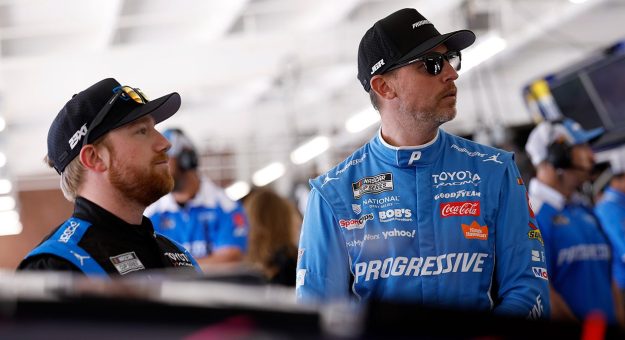
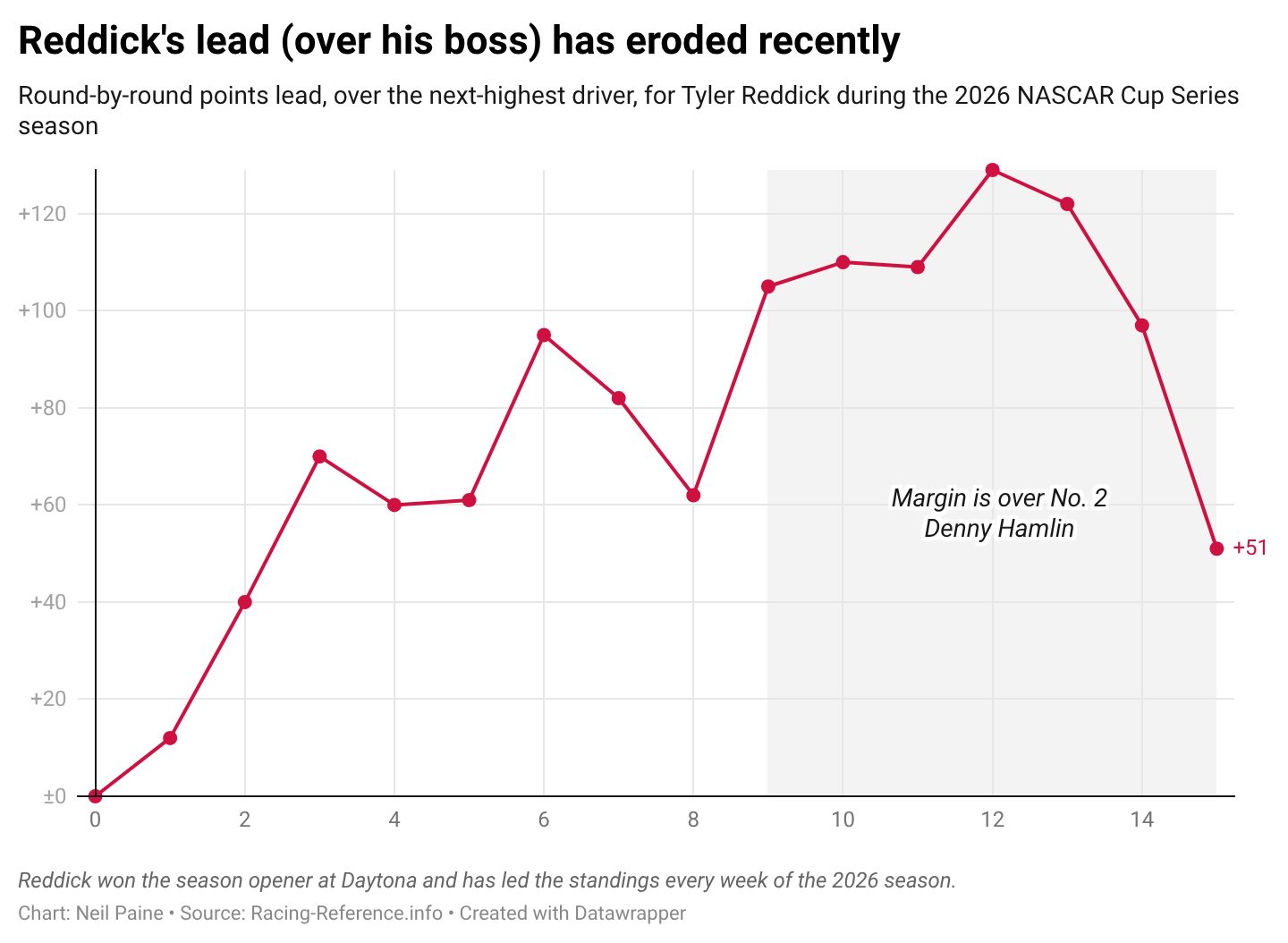
It wasn’t too long ago that Tyler Reddick seemed to be completely running away with the 2026 Cup Series’ points lead — and therefore, the coveted No. 1 seed in The Chase — as he pursued his first career championship. In the debut year of the retooled Chase format, each win is worth 15 more points than under the previous system, and nobody won more in the early going of this season (or, really, any season) than the driver of the 45 car. At one point, the wins helped supercharge his lead to 129 points with 14 races to go before the end of the regular season, a cushion that looked borderline insurmountable.
In recent weeks, however, Reddick has also been on the receiving end of the outsized effect that wins can have on the points race — specifically courtesy of his boss, Denny Hamlin.
From that peak gap of 129 points following Reddick’s top-five run at Watkins Glen, Hamlin’s own recent hot streak (finishing third at Charlotte and scoring back-to-back wins at Nashville and Michigan) has more than cut Reddick’s advantage in half. After Reddick crashed into a 35th-place finish Sunday, Hamlin is just 51 points back of Reddick with 11 races before the cutoff; a much more workable deficit to overcome.
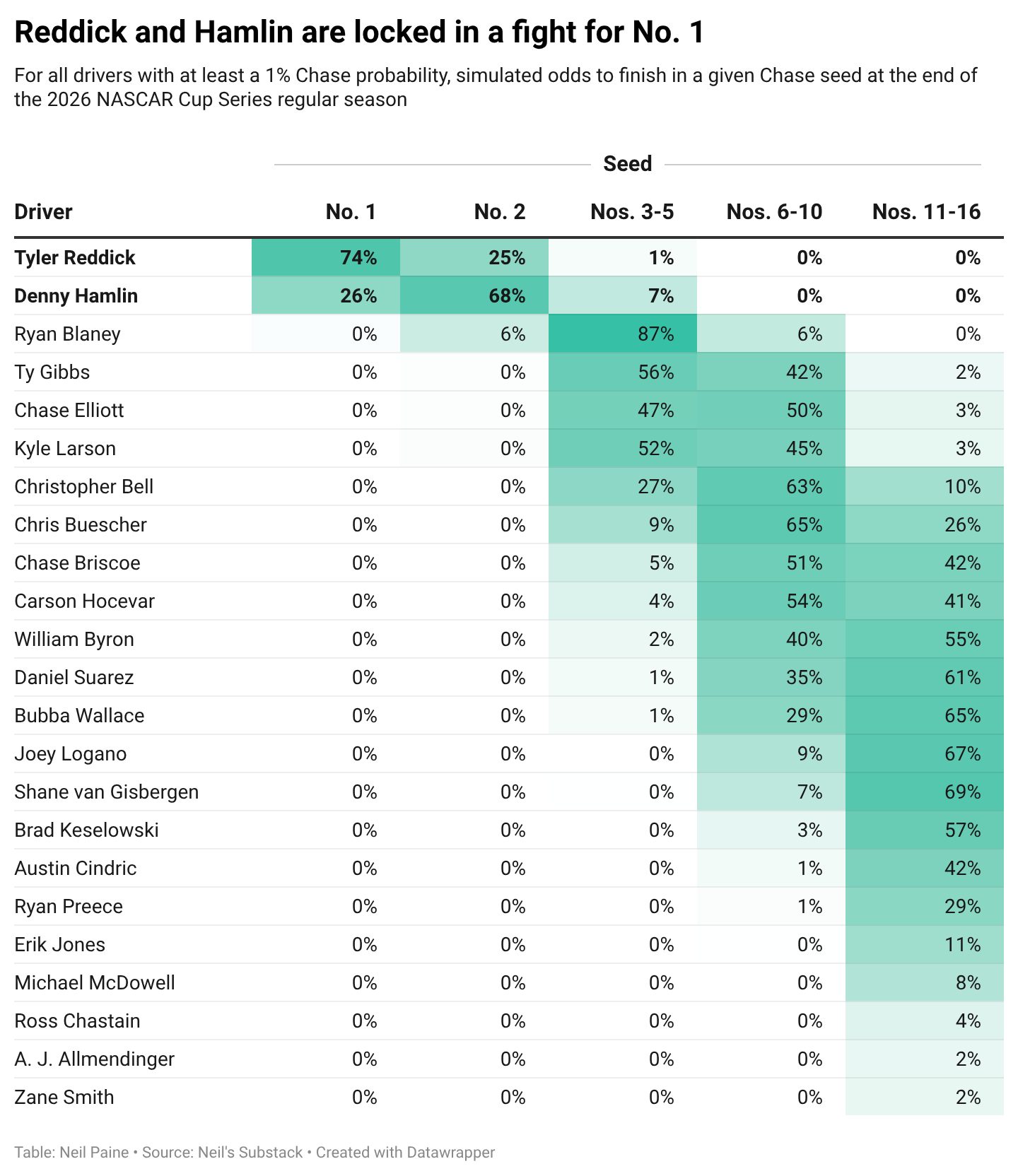
Now a battle for the points lead is back in play, even if Reddick still holds the edge. My latest forecast model simulations give Reddick a 74% chance to hang on and retain the No. 1 seed, with Hamlin sitting at 26%.
Fractionally, Ryan Blaney has a 0.5% chance to swoop in and steal it from both of the front-runners — but he’s currently 157 points back, so it would require a superhuman series of races from here. Effectively, this is a two-man race between the No. 45 team and the man who signs their paychecks for 23XI Racing.
WATCH: NASCAR video highlights
What needs to happen for Hamlin to continue hunting Reddick down — or for Reddick to hold Hamlin off?
Looking at the leverage of each race on the odds for either driver to be the No. 1 seed, it’s critical to avoid disaster at the chaotic, high-speed environment of Daytona and the pack-racing of Atlanta — but also big, flat Indianapolis Motor Speedway and the upcoming “Tricky Triangle” of Pocono, both of which can be underrated stumbling blocks for favorites as well. In simulations where Reddick finishes 30th or worse in at least two of the four remaining races at Pocono, Atlanta, Indy and Daytona, his odds at the No. 1 seed fall to 51%, while Denny’s drop to 8% under the same set of finishing circumstances. (Alternatively, those figures become 47% and 6%, respectively, in sims where they finish 20th or worse in 3 of those 4 races.)
Of course, each driver needs to take advantage of their specialties from here, too. On the remaining regular-season schedule, there are 11 total races:
- Two at superspeedway/drafting tracks (Atlanta, Daytona)
- Two at road/street courses (San Diego, Sonoma)
- Either three or four at both intermediate ovals (Pocono, Chicagoland, Indy) and short tracks (North Wilkesboro, Iowa, Richmond), depending on how you treat Loudon — which is 1.058 miles and flat, technically making it an oval, though it acts like Richmond and other short tracks.
Reddick is fairly close to Hamlin on ovals — he has a 114.3 Driver Rating to Denny’s 116.2 on them so far this season — which makes those either a wash or a slight advantage to the No. 11, at best. But Reddick is massively better on road courses; he has a 95.7 average rating on right- and left-turn tracks over the past three seasons, versus just 59.5 for Hamlin. And Hamlin is massively better on short tracks; he has a 105.2 average rating there over the past three seasons, versus just 73.4 for Reddick.
The greater number of additional short-track races relative to road courses is a built-in advantage for Hamlin. But Reddick has that 51-point lead in the standings, which more than balances things out. Either way, whichever driver can stick closer to their rival on the other’s preferred stomping grounds will have the inside track to the top seed.
And maybe the most important thing of all for Hamlin is to keep defying Father Time. He is already one of the most productive and successful Cup drivers ever in his 40s, running side-by-side with the great David Pearson for the title of sixth-best modern-era driver in the 40-or-over set, according to a combination of actual and expected (based on race-to-race Driver Ratings) wins:
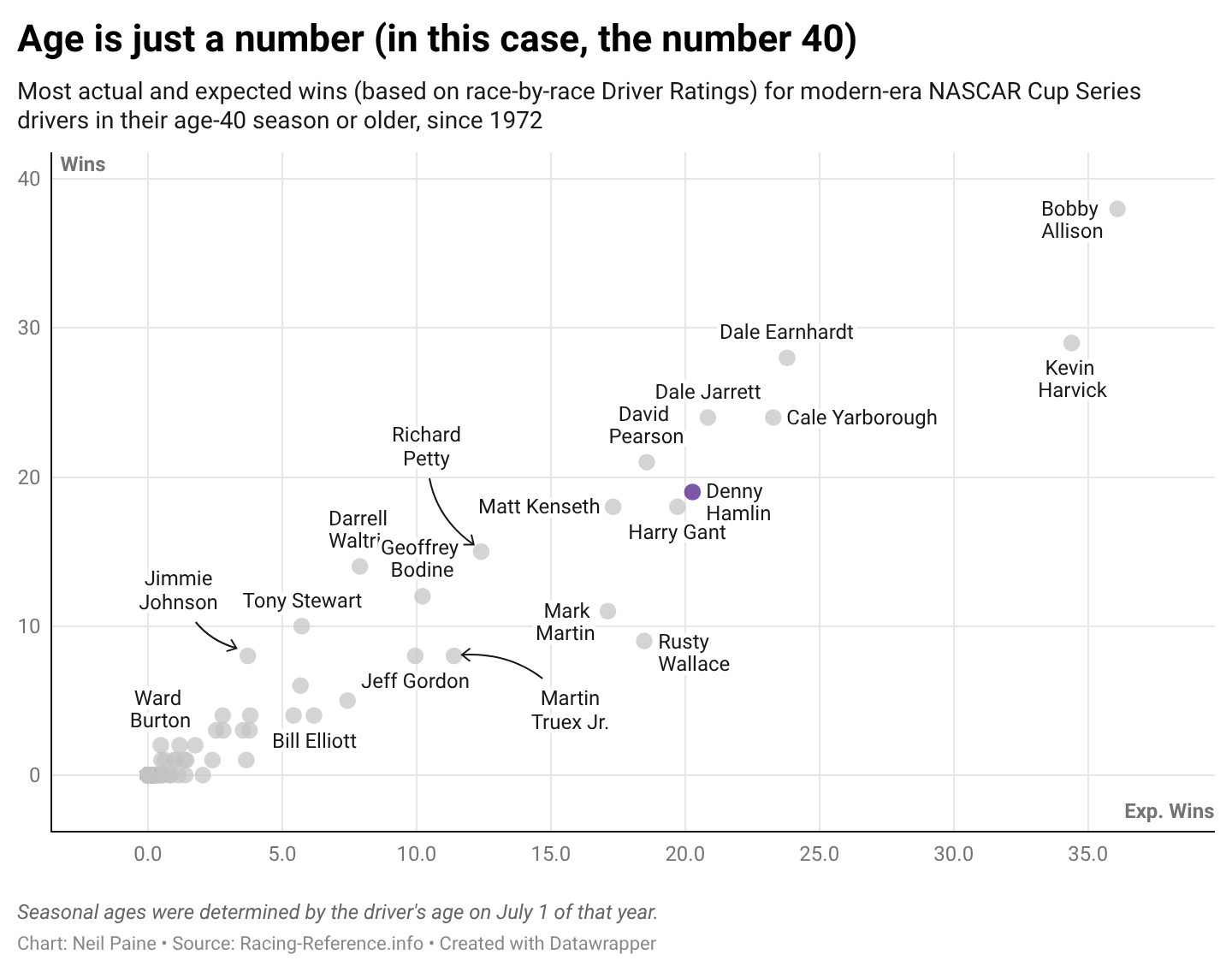
But he’s outdoing himself this year at age 45. A year after the age at which Jimmie Johnson and Martin Truex Jr. had stopped being full-time drivers — or when Jeff Gordon last drove, period (just to name a few greats that put down the steering wheel by this point) — Hamlin just won his third race in 15 starts and is arguably having his best season ever. That’s at least true in terms of finishing quality relative to the field: His average finish of 8.3 — 57% better than Cup average — is the lowest he’s ever had in a season and his 227 Adjusted Points+ index is the highest it’s ever been, while his average Driver Rating of 103.7 is second only to the 109.4 he put up in 2021.
It’s nearly unprecedented to see that level of performance from a 45-year-old. Hamlin’s normalized average finish is just 43% of the Cup average — lower is better — which ranks second all-time to Bobby Allison in 1983 and Cale Yarborough in 1984 among 45-plus year-olds. His 227 Adjusted Points+ index is fourth-best behind Allison/Yarborough and Dale Earnhardt Sr. in 2000. And his 103.7 Driver Rating once again trails only Yarborough and Allison.
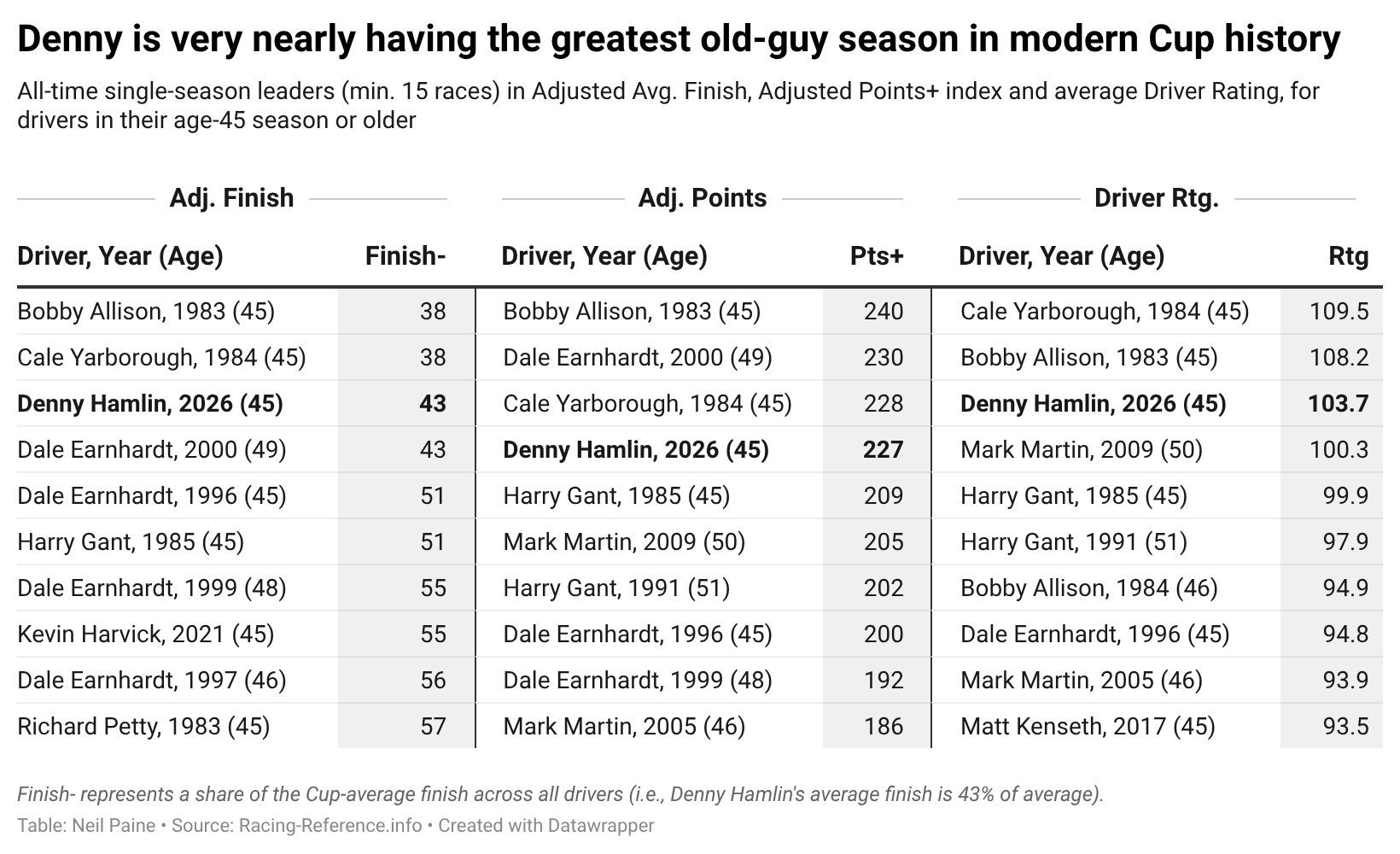
(It’s no coincidence to see Mark Martin well-represented on the list; he was putting up seasons to rival Hamlin’s 2026 at age 50! And he’s also Hamlin’s only real rival for the crown of “best driver to never win a championship”, with apologies to Junior Johnson and Fireball Roberts.)
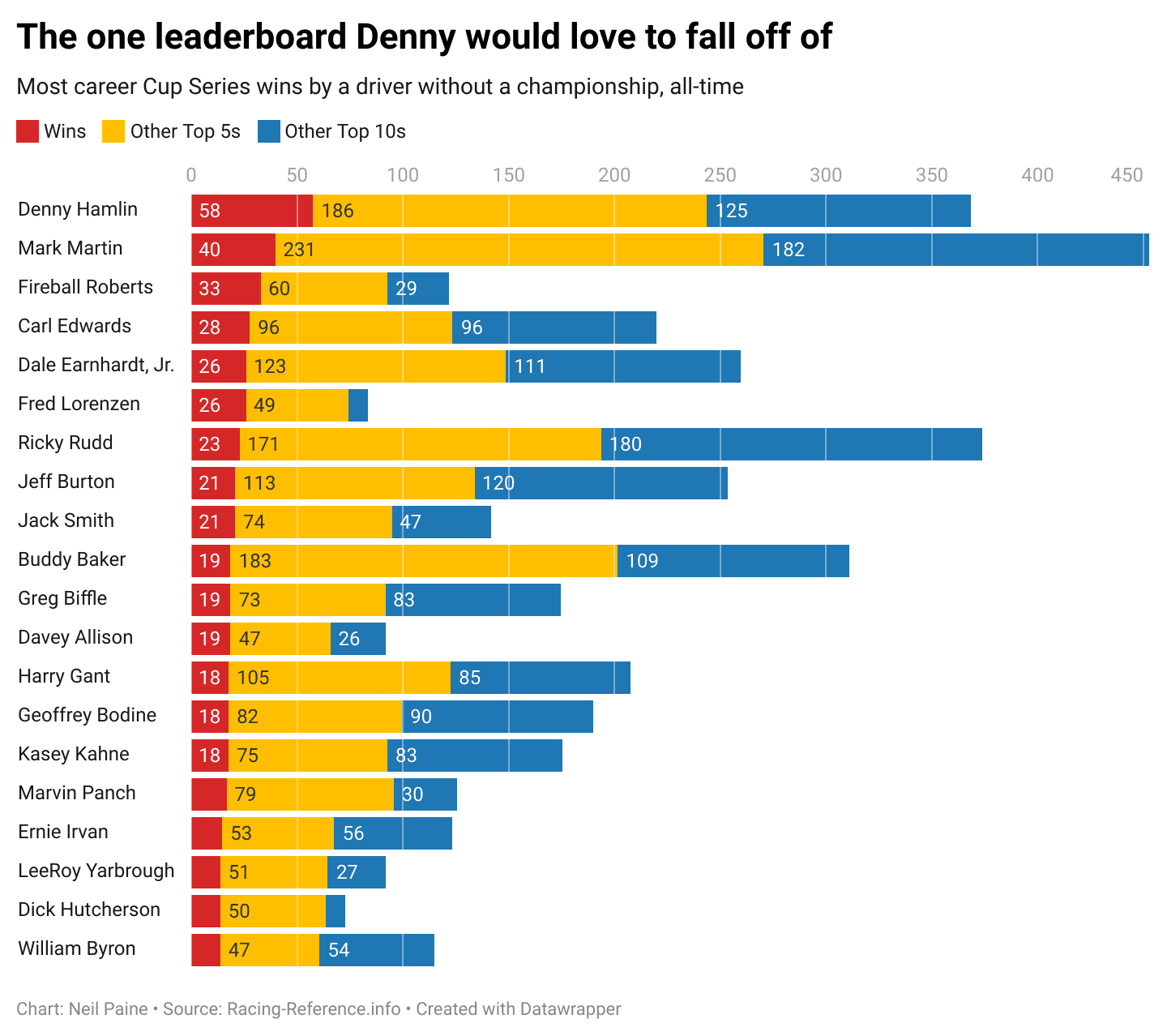
As long as Denny keeps driving at a historically ageless level — which he’s been doing for a long time now, yet he keeps topping himself — he will give himself a chance to track down Reddick by the end of the regular season, which in turn would provide a nice cushion in the standings ahead of The Chase as Hamlin seeks that elusive first Cup title.
Maybe this just proves that no points lead is truly safe under the new system’s win bonus. Or maybe just that Denny Hamlin still isn’t done adding to his future-Hall-of-Fame resume, not by a long shot.