
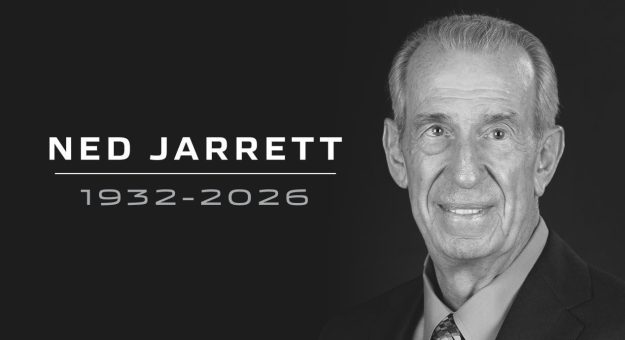
Ned Jarrett, twice a NASCAR premier-series champion as well as a second-year inductee into the NASCAR Hall of Fame and one of the first competitors to make a successful transition from the race car to the television booth, has died. He was 93.
The Jarrett family made the following statement: “With profound sadness, the family of NASCAR Hall of Fame driver and radio/TV personality, Ned Jarrett, announces his passing on Thursday, June 4, 2026. He died peacefully of natural causes at his home in Newton, North Carolina, with his family by his side. He was 93 years old. Our father was a devout Christian and a devoted, loving family man. He was a friend to everyone he met and NASCAR’s oldest living champion. By all accounts, he was a true NASCAR legend. While we mourn his passing, we celebrate the remarkable life of an amazing man and truly the best father anyone could have wished for. Rest in Peace, Dad.”
“Despite his calm demeanor, ‘Gentleman’ Ned Jarrett was as fierce a competitor as NASCAR has ever seen,” NASCAR CEO Steve O’Donnell said in a statement. “His on-track accomplishments speak for themselves with wins and championships across several NASCAR divisions. But it was his off-the-track persona that separated Ned from his peers. He was as kind as his nickname indicated. And his endearing personality helped him excel in his second career as a broadcaster. Ned was an outstanding ambassador for the sport for more than six decades, and he will be dearly missed. On behalf of the France family and all of NASCAR, I offer my deepest condolences to all of Ned’s family and friends on the loss of a NASCAR legend.”
The third driver to win at least 50 NASCAR premier-series races, Jarrett won championships in 1961 and 1965 in what is known today as the NASCAR Cup Series. He is also a two-time Sportsman champion, claiming back-to-back titles in 1957 and ’58 after finishing second to Ralph Earnhardt in ’56.
Jarrett holds the record for the premier series’ largest margin of victory — claiming the 1965 Southern 500 at Darlington Raceway by a whopping 14 laps.
His 50 career wins came in just 352 starts during a career that lasted 13 years, from 1953 through 1966. However, he ran more than half the scheduled races only six times.
In that short span, Jarrett still totaled 185 top-five finishes and 239 top-10 results.
His championships came with two team owners — his ’61 title was won while competing for shipping heir B.G. Holloway, while his ’65 title came with owner Bondy Long.
It was also in ’65 that Jarrett suffered his worst injury in racing — breaking his back in a crash at Greenville-Pickens Speedway.
That injury, and the temporary withdrawal of Ford Motor Company from stock-car racing the next year, hastened Jarrett’s retirement at the age of 34.
“With the help of a lot of good doctors and a lot of people, we were able to keep going and finish out the season and went on to win the championship,” Jarrett said during his NASCAR Hall of Fame acceptance speech in 2011. “I’m very grateful for that.”
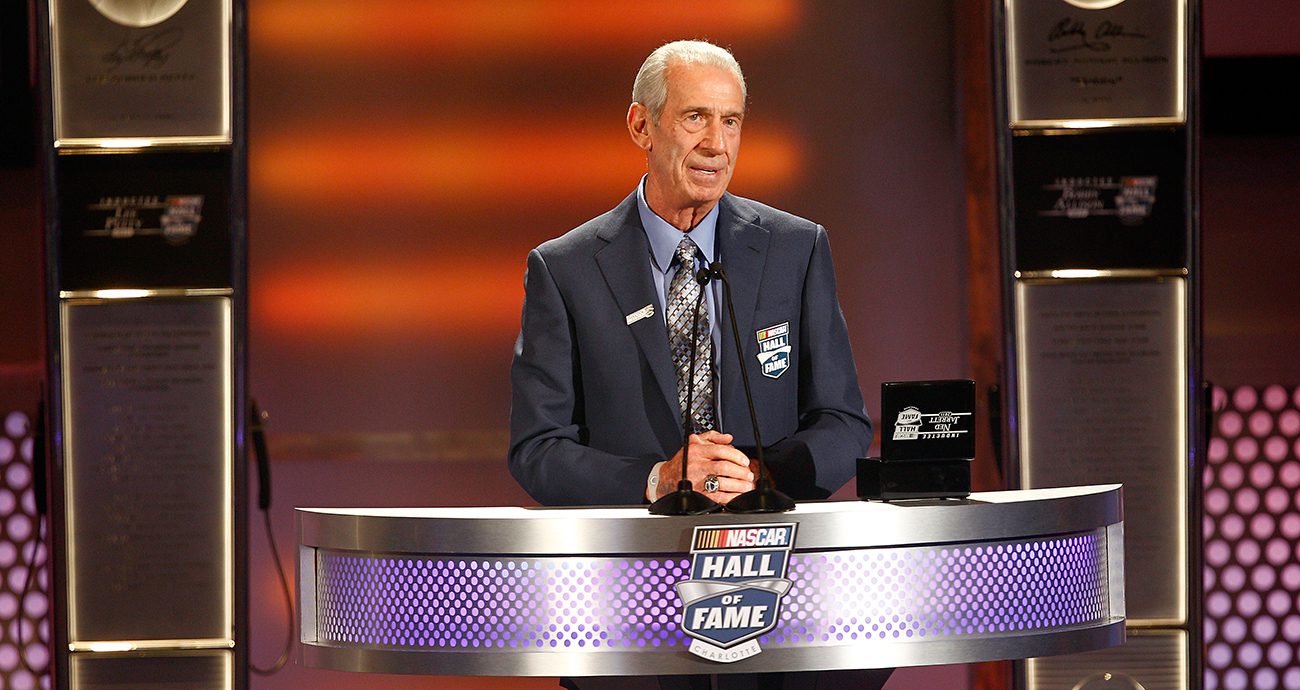
Jarrett was named one of NASCAR’s 50 greatest drivers in 1998, and his 43 victories in Ford entries remain tops for that manufacturer.
After his retirement from driving, Jarrett quickly became a fan favorite behind the microphone. “Ned Jarrett’s World of Racing,” a daily radio news show, became a staple among those in the sport and those who followed it.
He worked with the Motor Racing Network (MRN) as a pit-road reporter before moving to the television booth, where he enjoyed stints with CBS and ESPN. His call for CBS of the final laps of the 1993 Daytona 500, in which his youngest son, Dale Jarrett, held off (at the time) five-time series champion Dale Earnhardt for the victory, remains one of the most memorable calls in NASCAR.
“C’mon, Dale, go baby, go,” the elder Jarrett said as the final lap unfolded, urging on his son while a national television audience listened in. “… Don’t let him (Earnhardt) get to the inside of you coming around this turn. Here he comes, Earnhardt; it’s the Dale and Dale show as they come off of Turn 4.
“You know who I’m pulling for, it’s Dale Jarrett. Bring her to the inside, Dale, don’t let him get down there. He’s gonna make it! Dale Jarrett’s gonna win the Daytona 500! Alright!”
Ned Jarrett was born Oct. 12, 1932, near Newton, North Carolina, and grew up working on his family’s farm and sawmill. When talk of a new race track, Hickory Speedway, became hot news in the community, Jarrett began making plans to compete when the track held its first premier-series event in 1953.
“I played a little basketball and baseball in high school (and) thought I had some athletic ability,” he said. “When they opened the speedway, I ran the first race they ever run there. I was hooked.”
Racing was little more than a hobby at that time for Jarrett, who said he won half interest in his first race car in a poker game.
When he began running in the Sportsman Series full-time and winning regularly, he started to consider moving up to the premier series, where he could try to race for a living.
When no car owners came calling, however, Jarrett found himself still competing in Sportsman races. After one particularly stressful night, Jarrett said he told others he needed a change. “I need to get in a car that will win a race for me or run up front on a consistent basis,” he said.
What followed remains one of the more interesting stories in NASCAR lore.
After his induction into the NASCAR Hall of Fame in 2011, Jarrett shared the story with members of the media.
“There was a 1957 Ford for sale, being maintained in my hometown,” Jarrett said. “Junior Johnson was winning on a fairly regular basis in that car. They were building Junior a new Dodge to run at Darlington that year, 1959.”
The owners wanted $2,000 for the car. Jarrett didn’t have $2,000, but he did have a plan — which was to write a check for the car after the bank closed on Friday, meaning it would be at least Monday before the money could be drawn out of his account.
“There was a 100-mile race, pays $950 to win Friday night at Myrtle Beach,” he said. “There was another race on Sunday afternoon in Charlotte that pays $950 to win. That’s $1,900. I can cover that check on Monday morning.
“You can’t be foolish enough to try that, but I did. I had no doubt in my mind. I was cocky enough to believe if Junior Johnson could win races in that car, I could, too.”
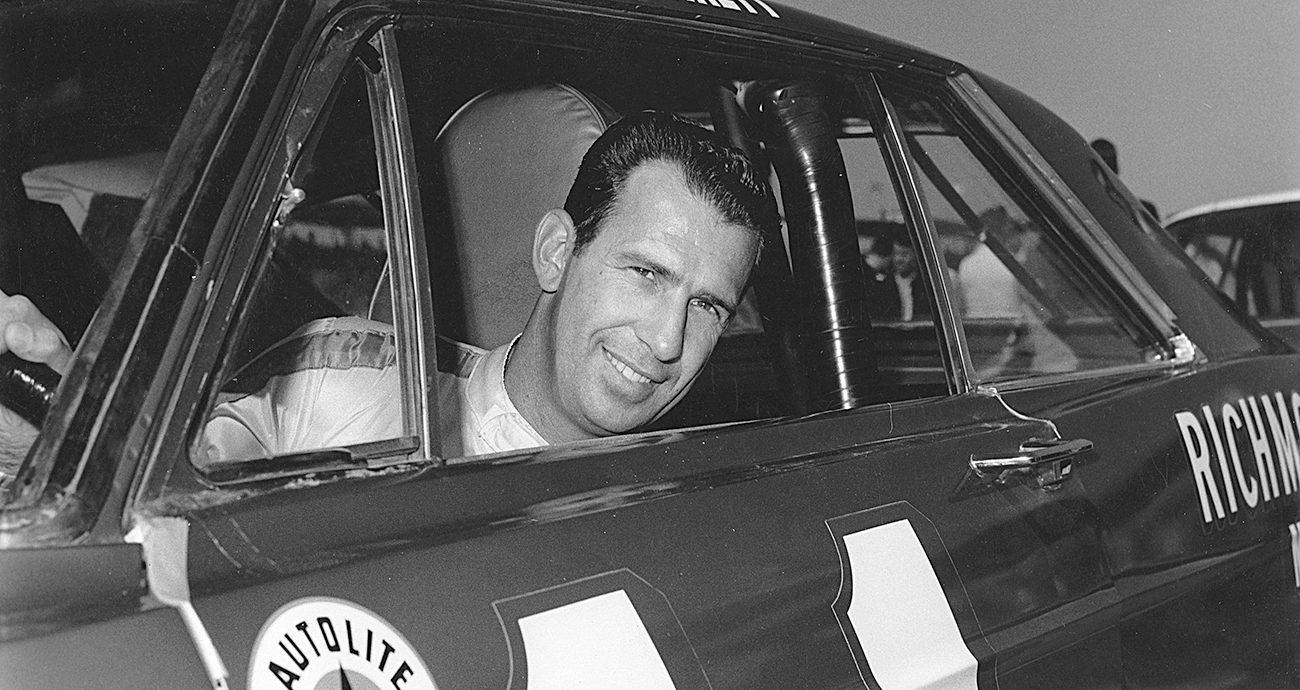
The result was Jarrett’s first two premier-series victories as he won back-to-back events at Rambi Raceway in Myrtle Beach, South Carolina, on Aug. 1 and Southern States Fairgrounds in Charlotte, North Carolina, on Aug. 2.
“We were able to pull it off,” he said. “… That’s what launched me into the Grand National Series.”
Jarrett won five times the following season as he ran 40 of the 44 races on the schedule and finished fifth in the points standings.
In 1961, he hooked up with Holloway and Chevrolet — thanks to a recommendation from 1960 series champion Rex White — and won his first title despite winning only one race. He finished in the top five in 23 of his 46 starts, outpointing White for the title.
Jarrett won a career-best 15 races driving for Long in 1964 but finished second to Richard Petty in the battle for the championship.
In the ’64 running of the World 600 at Charlotte Motor Speedway, Jarrett helped pull a critically injured Fireball Roberts from his burning car after a crash. Roberts suffered third-degree burns, while Jarrett was treated for minor burns.
Roberts, one of NASCAR’s first superstars, died two months later while still being treated for his injuries.
The ’65 season saw Jarrett win 13 more times and capture his second series title. Included in his victories was the stunning 14-lap winning margin at Darlington. He made his final start the following year, finishing third in Rockingham while driving for Long.
Besides a driving and broadcasting career, Jarrett also took a turn as a track promoter, running Hickory Speedway from 1968 through 1977. He was named Promoter of the Year twice for his efforts.
All three of Jarrett’s children — sons Dale and Glenn and daughter Patti — have NASCAR ties.
Dale Jarrett won the NASCAR premier-series title in 1999 and retired with 32 career victories. He was inducted into the NASCAR Hall of Fame in 2014.
Glenn Jarrett competed in both the Cup Series and NASCAR O’Reilly Auto Parts Series before embarking on his own broadcasting career, while his daughter, Patti Makar, is married to Jimmy Makar, who was the Senior Vice President of Racing Operations for Joe Gibbs Racing.
Ned Jarrett was preceded in death by Martha, his wife of 67 years, on Feb. 5, 2023.
In January of 1963, Ned Jarrett spoke to the Associated Press about the business of running a race team, its pitfalls as well as its advantages.
“There’s very little glamour in this business of stock-car racing,” Jarrett said at the time. “It is hard work. To make money in it, you’ve got to run your team like you would any other business.
“You’ve got to match dollars that go out with dollars that come in. You can’t live on fame.”