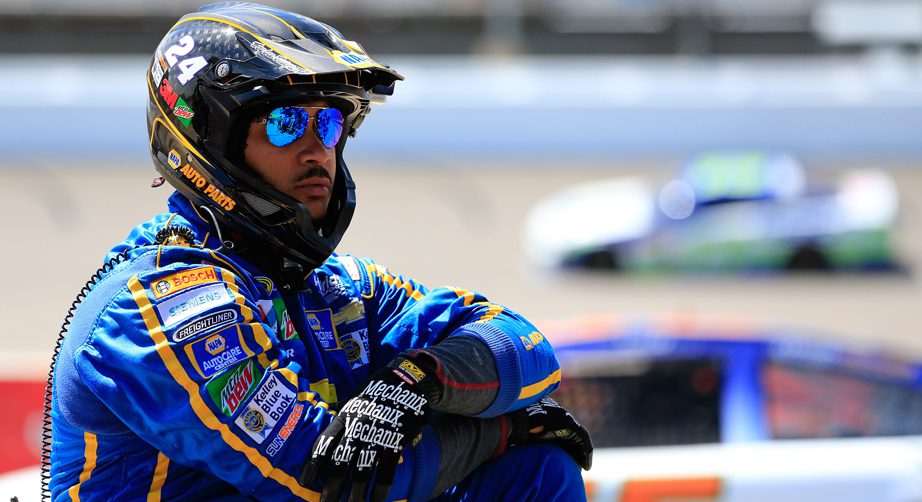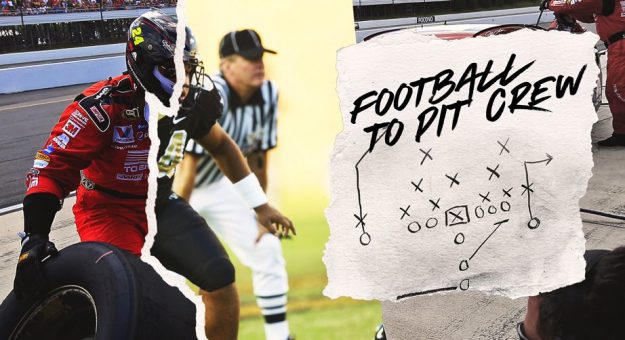
When NASCAR hosts the Busch Light Clash on Feb. 6 at the legendary Los Angeles Memorial Coliseum (6 p.m. ET, FOX, MRN, SiriusXM NASCAR Radio), the race will hold special meaning for dozens of current Cup Series pit-crew members.
Some of those pit-crew members previously played college football in massive stadiums like the 78,500-seat Coliseum. Many ultimately wound up taking their athletic talents to the world of stock car racing.
The juxtaposition is easy to understand.
Because of the agility, speed, strength and versatility they showed on the gridiron, those football players have transferred those same talents into roles such as jack men, tire carriers, tire changers and gas men in NASCAR.
One of the pioneers of pigskin-to-pit-road is Dion “Rocko” Williams, who has worked in NASCAR for nearly 20 years, with more than a decade on pit road for several teams and currently as a recruiter and mentor to athletes who’ve followed in his footsteps and an analyst for NASCAR.com.
He has an idea what pit-crew members will feel staring up at the packed stands on Sunday.
“At the Coliseum, walking through the tunnel to the track … you get goosebumps,” Williams said. “Or like at Daytona, driving through that tunnel, and when you emerge and see the palm trees and the stands, that’s where you get the feeling. It’s the same feeling you had when you were getting off the bus in your shoulder pads and the crowd was waiting for you to walk into the stadium to begin the football game.
“I mean, it’s the goosebumps and tingling feeling that drives most (of us) to the long careers in a sport because we can’t get that working a regular job.”
Williams played his football at Wake Forest University, which is just six miles from legendary Bowman Gray Stadium, which sits on the Winston-Salem State University campus. The racing surface there rings the outside of the WSSU football field.
There used to be a number of “stadium race tracks” that NASCAR raced on in the 1950s and 1960s, but 17,000-seat Bowman Gray is now one of the few remaining.
That’s why the Clash at the Coliseum, on a man-made, quarter-mile track also built around the edge of the football field, is such a significant event for the sport, essentially revisiting the racing of old with the racing of today.
“There’s many parallels between football and NASCAR,” Williams said. “And one of the biggest and one that resonates the most is when you’re standing on that wall holding that tire, and you’re looking up and you’re seeing the grandstands filled and packed, it provides perspective and the butterflies that you had (back when you were playing college football) when you were on the field and it was fourth and long. I mean, if you could bottle that feeling up, that’s what you feel.”
RELATED: Full event schedule, buy tickets | NASCAR‘s history racing at stadium venues
Williams’ journey to NASCAR started one day many years ago. A friend of Williams’ who raced at Bowman Gray asked the former football star to join him. “Unbeknownst to me, I was his security guard,” Williams said with a laugh, unwittingly being brought along to help protect his buddy if he got into a fight with another racer.
Before that, Williams had no involvement with NASCAR. “I knew nothing about it,” he said. “I grew up 25 minutes from Atlanta Motor Speedway and never knew (NASCAR) existed. It was always stick and ball sports for me. All I knew was Jeff Gordon, Dale Earnhardt and the M&Ms racing jackets. It was my friend who planted the seed, saying ‘you’re so big and strong, you’d kill it.’”
Williams eventually met Phil Horton, who was the head strength coach at Chip Ganassi Racing at the time in 2004. Horton, who is now Rev Racing’s director of athletic performance and pit crew coach for NASCAR‘s Drive for Diversity Crew Member Development program, sent out a number of fliers advertising an open tryout at CGR, and Williams joined several other athletes who attended and made the cut.
“(Horton) explained to me and four other football players and one baseball player that we were an experimental team,” Williams said. “We were going to get paid $200 a week just to practice how to put tires on a car, how to jack it up, with the hopes of pitting the car. We were eventually fast-tracked, and six months later, we were pitting the car for Sterling Marlin in the 2005 Daytona 500.”
Things didn’t exactly go according to plan, though, Williams recalled with a sheepish laugh.
“Our first pit stop out of the box, we sent (Marlin) out with only three tires, sparking down pit road,” he said. “We also did an ARCA race with our football helmets on. This was before they were mandated. I had my Wake Forest helmet on, another guy wore his Chapel Hill (North Carolina) helmet, another guy from Lenoir-Rhyne (University in Hickory, North Carolina). That was the type of vibe, it was all experimental and new, but it caught on because we were so much faster than everybody else. Plus, with our work ethic, all we did was practice all day. Once I felt that vibe and competition, man, I just didn’t want to get beat.”
Williams went to Petty Enterprises (2006-07) and then Hendrick Motorsports (2008 through 2016), including being a part of Jeff Gordon‘s pit crew. He then joined Horton, overseeing recruiting, training and development for over a dozen teams in both the Camping World Truck Series and Xfinity Series.
Williams still serves as a recruiter for NASCAR’s Drive for Diversity efforts, with more than 60 former college athletes in pit crew development. In fact, he’ll spend part of the week leading up to The Clash evaluating a number of potential prospects who are current athletes — primarily football players — at the nearby University of Southern California (USC).
RELATED: Pit crew development program leaves lasting mark
The 40-year-old Williams is particularly excited about the 2022 NASCAR Cup season. Not only will it mark the rollout of the heralded Next Gen car, but after nearly 70 years of tires being attached to race cars by five lug nuts per wheel, this year that also changes to a single center-locking lug nut hub per wheel.
Williams believes that change will be as revolutionary to pit stops as bringing in former football players to pit crews has turned out.
“Depending on how (teams) figure out how to do it, it’s going to (make pit stops) two seconds faster, give or take,” he said. “You won‘t have to hit five studs, but you are still going to have to hit that one.
“The feel is going to be different. And the run-around the car is going to be faster because your jack man and tire carriers are all going to have to speed up by two seconds. It’s going to make things all the more athletic. Fuel mileage is going to come more into play, we‘re going to have more pit stops due to the smaller fuel cells, and performance on pit stops is going to play a bigger role, more so than normal, because you’re going to have more pit stops and the stops are going to be faster.”
NEXT GEN: Development, testing and launch of 2022 Cup Series racer
Williams likes to joke, “I can talk about pit stops and pit crews all day long,” but there’s a lot of seriousness mixed in with the humor. He’s done extensive TV and radio work over the years that has focused on pit crews and pit stops, including the “Pit Stall Analysis” show for NASCAR.com and the weekly “MRN Crew Call” for the Motor Racing Network.
“Ultimately, my goal is to eventually end up in the booth, calling races, and especially highlight pit stops during the race the way they should be highlighted, from an athletic perspective rather than a driver’s perspective,” Williams said. “Recruiting came about just coincidentally but also out of necessity because we had to do something with the athletes reaching out to me. And I had the access to place them.”
Currently, there are more than 60 athletes involved in the Drive for Diversity program who work on various teams in Cup, Xfinity and Trucks. Many are on backup/reserve development pit crews, working hard and waiting for their chance to step in if they are suddenly needed when a starter on a pit crew gets injured or sick.
“You always have competition,” Williams said. “Every year, you have to earn your spot when you’re attached to a car that can win every single week. That’s a different type of skill set that’s necessary. When you recruit, you can’t always see that right away, but the athletes that have that, when they’re competing, they have long, fruitful careers.”
**********************************************
One of the most notable recent football-to-NASCAR pipeline members is Brandon Johnson, who became the lead jack man for the No. 5 Hendrick Motorsports Chevrolet last season and played a key role in helping Kyle Larson earn 10 wins and the Cup championship.
WATCH: Larson goes from fourth to first on pit road in final pit stop of season
Johnson played football at Penn State and had always dreamed of playing in the NFL. But he got injured in his first pro training camp, and after two more tries, he decided to try NASCAR. It’s a decision he’s never regretted.
“The toughest part for me was actually being able to let go of football,” the Pittsburgh native said. “A lot of people that go through what I’ve gone through, they still feel like they have it, and when it comes time for that decision to give up on football, it‘s a gut punch. I didn’t want to be that person who’s 33 years old, still chasing the NFL dream and then nothing comes out of it, and then NASCAR was gone and I have nothing and I have to work a regular factory job.
“Eventually, I had to make a hard choice, either to keep chasing football and the NASCAR opportunity goes away. It was a tough call, but I’m glad I made it.”
Johnson fell short of making the reserve team — similar to an NFL team’s taxi squad — at Hendrick Motorsports in 2016, the same year he graduated from Penn State, but came back two years later and made it.
“To make the transition was pretty simple because it still resembles football in a way, the working out and all the dedication,” he said. “The only thing that changes is the physical aspect, where I’m not carrying a football anymore but instead I’m carrying a jack. The transition is not as hard as people think.”
There are about 40 athletes — starters and reserves — on the Hendrick Motorsports pit crew roster this year. Given the success Hendrick and organizations like it have with their respective pit crew recruiting of former athletes, it’s not surprising that current football players frequently reach out to NASCAR athletes such as Johnson.
“Many people ask what’s it like and how do they get started, and I give them a pretty straightforward answer,” Johnson said. “There’s a lot more people that are opening their eyes to it. I know I’m glad I did it. I’m very thankful, very blessed and appreciative.”