
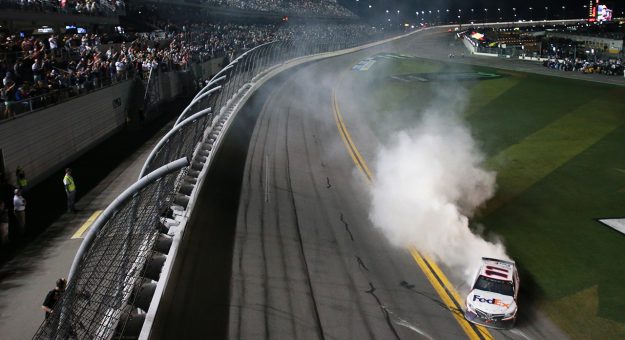
It turned into “The Late American Race,” but Denny Hamlin is not complaining.
Sunday’s 61st running of the Daytona 500 lasted more than four hours thanks to two red flags displayed after a pair of multi-car accidents. It came down to an overtime shootout between Hamlin and Joe Gibbs Racing teammate Kyle Busch and when the checkered flag flew it was the No. 11 FedEx Toyota in front of the field.
The electric finish capped a day punctuated by tight competition in the first 400 miles only to be interrupted by a series of accidents in the final 100.
See Also: Race Recap and Results
There was great consternation all week long about what kind of on track product the Monster Energy NASCAR Cup Series would produce after an admittedly lackluster Speedweeks in last week’s Advance Auto Parts Clash and Thursday’s Gander Outdoors Duel 150 mile qualifying races.
But those questions were answered quickly when two-by-two racing was on display literally at the drop of the green flag only to be replaced by three-wide competition in the latter stages. Those tight quarters were unfortunately the proponent for contact, which led to a great deal of carnage.
The race started an important year for NASCAR as the sport looks to gain some momentum. Sunday’s race was filled with memorable moments and a thrilling finish.
It wasn’t a masterpiece by any means. But as Daytona 500’s go, this year’s running was still an intriguing piece of art.
- Working together was an obvious theme in Sunday’s Daytona 500. Once again the Ford stable had a plan in place and executed it nearly to perfection all day long. It forced other teams and drivers within manufacturer and organization camps to find ways to combat the Fords. While Sunday’s race marked the end of the restrictor plate era, teams will now have a tapered spacer going forward beginning at Talladega in April, which will create the same result of limiting horsepower. Teamwork will still be necessary and it will be interesting to see how groups react to how Daytona played out.
- The best thing you could say about Saturday’s Xfinity Series race was it delivered a first-time winner in Michael Annett. The veteran driver, who had gone winless in eight seasons, finally broke through to make his first trip to Victory Lane. But overall the race lacked much in the way of drama or competition, including the final dash to the checkered flag when most everyone stayed in line. It was a puzzling afternoon with a range of theories as to why there wasn’t more in the way of side-by-side racing or passing. Some pointed to the superspeedway package and its aerodynamic challenges while others believe the drivers did not want to push the envelope. Whatever the reasons the race won’t be one remembered for very long. Thankfully it wasn’t a precursor to the Daytona 500.
- The polar opposite of the Xfinity Series race took place in Friday night’s Gander Outdoors Truck Series season opener. It also ended with a first-time winner in Austin Hill, who was ahead of only eight other trucks left running at the finish. A total of 55 laps were run under caution thanks to a series of multi-truck crashes and accidents. It’s become more the norm for the trucks at Daytona but Friday night was an extreme example of what can happen. Thankfully only trucks and not drivers were damaged in the long night. And as it turned out, it actually was a precursor to the Daytona 500.
- On a personal note Sunday marked the final race for long-time NASCAR official David Hoots. The respected race director stepped down from the position after the Daytona 500 after several decades with the sanctioning body. His famous command to “put it out” when caution needed to be displayed will be missed as will his steady direction. All of us at MRN wish the best to David.
The opinions expressed here are those of the writer and do not necessarily reflect the positions of the Motor Racing Network.


